-
Oil under $100, Mortgage rates improve. What is “Carry Trade”
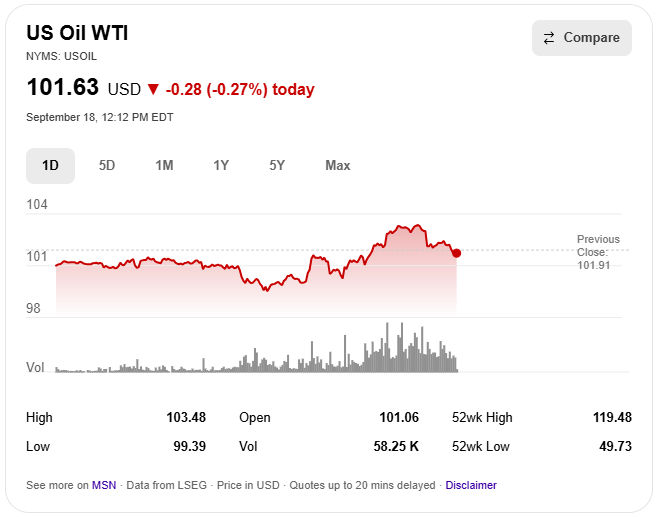
Oil has dropped below $100 a barrel this morning, and that’s giving the bond market a nice boost. Lower oil prices ease inflation worries, which is helping push mortgage rates lower today.
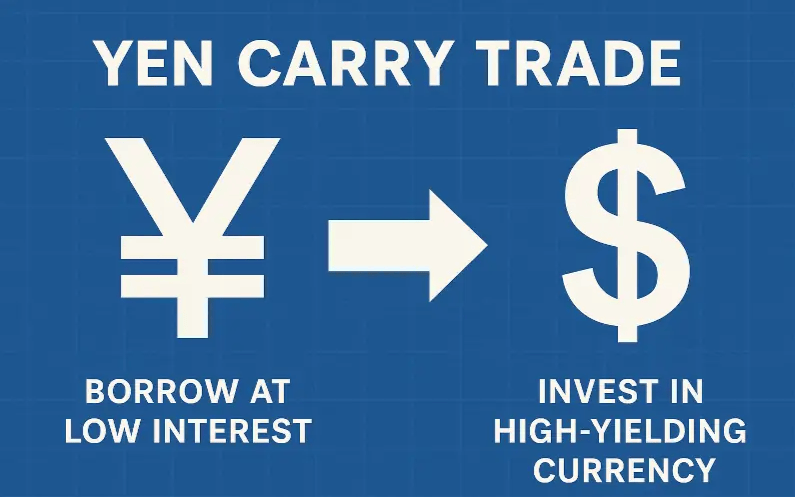
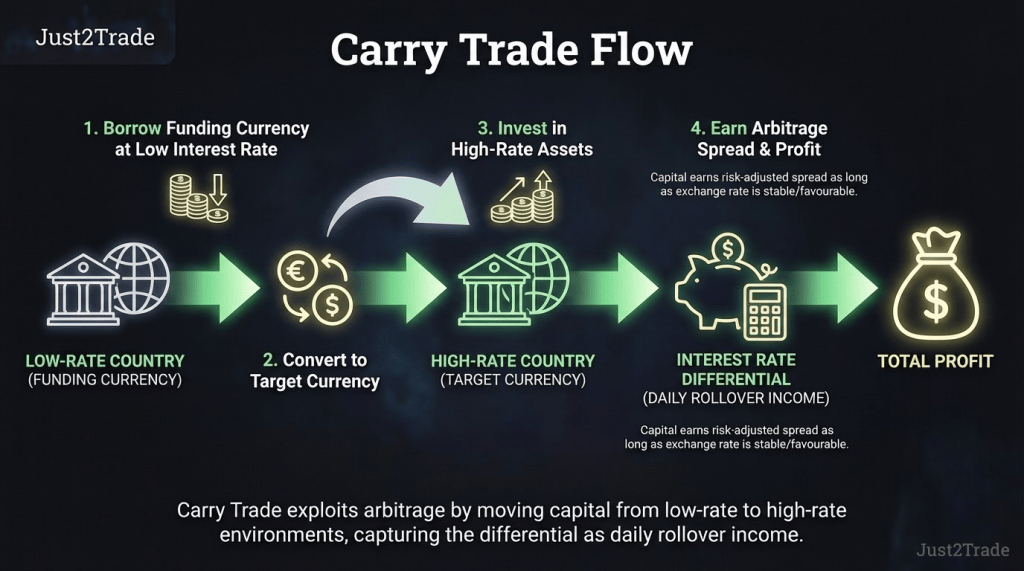
A quick note on the “carry trade” and Japan’s role in U.S. bonds: Japanese investors are among the largest foreign holders of U.S. Treasury bonds, largely through what’s known as the “carry trade”, borrowing money cheaply in Japan (where interest rates have historically been near zero) and investing it in higher-yielding U.S. bonds to pocket the difference.
When Japan’s own interest rates shift, or their currency moves significantly, it can trigger these investors to pull back on that trade, sometimes at a large scale. That matters for us because a pullback in Japanese demand for U.S. bonds can push our bond yields (and mortgage rates) higher, while renewed buying tends to help rates ease. It’s a good example of how closely U.S. mortgage rates are tied to global money flows, not just domestic news.
Have a fantastic week, and don’t hesitate to reach out with any questions!
Let’s get you pre-qualified http://www.YourApplicationOnline.com
-
Stocks Mixed, Saudi Arabia pipeline being fixed, Rates holding. Time to buy.

The stock market and Mortgage Bonds are lower to start the day as news broke that Saudi Arabia’s East-West pipeline is being repaired, restoring roughly 50% of pre-war production.
Turns out nothing calms jittery markets quite like the promise of more oil flowing, supply worries ease up, energy prices cool off a touch, and traders react accordingly. It’s a reminder of just how tightly global bond and stock movements are tied to headlines happening thousands of miles away.
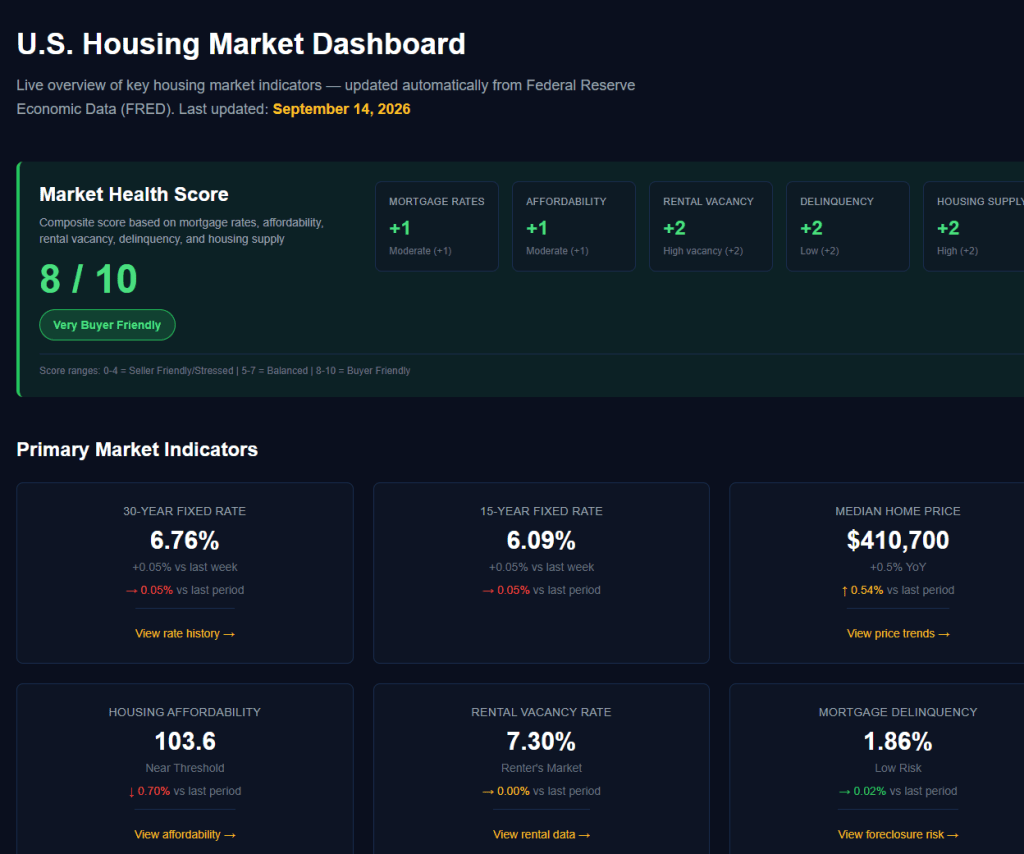
On the housing front, Pending Home Sales in August rose 0.3%, a small but welcome sign of life. The catch: sales are still down 4.7% year-over-year, largely thanks to stubbornly high interest rates keeping would-be buyers on the sidelines.
Fewer people are willing to “take the plunge” right now, which, counterintuitively, could actually work in a buyer’s favor. Less competition often means more negotiating power, more inventory to choose from, and sellers a little more motivated to make a deal happen.
So if you’ve been waiting for a sign, this might be it: less crowded market, sellers a bit more flexible, and rates that, whenever they do ease, could bring a wave of buyers right back in with you already ahead of the pack.
Have a fantastic weekend, and remember, reach out any time you have questions! http://www.YourApplicationOnline.com
-
De-ja vu

If it quacks like a duck, waddles like a duck, and drones on about “data dependency” for forty-five minutes, it might just be Jerome Powell wearing a Kevin Warsh nametag.
Honestly, watching Warsh speak yesterday was like watching a cover band play the Fed’s greatest hits.
Same chord progression, same mic-drop non-answers, same “we’re closely monitoring incoming data” while incoming data is somewhere in the parking lot, still not here yet. I kept waiting for him to say something, anything, that Powell hasn’t already said in a beige suit at a podium.
Instead I got the monetary policy equivalent of a Xerox of a Xerox.
The odds of another .25% hike before year-end are climbing faster than my blood pressure watching this press conference. At this point the Fed’s dot plot is less a forecast and more a haunted house, every time you think you’ve reached the exit, another quarter-point pops out and screams “SURPRISE.”
The Fed keeps swinging at inflation like it personally insulted their mother, when the actual culprit is oil prices doing backflips because of the conflict in Iran. It’s like trying to fix a leaky roof by yelling at your electric bill. Wrong problem, right amount of confidence.
I’m Ok, just a bit rattled by what I heard yesterday.
Let’s get you pre-approved and ready to hit the ground running. http://www.YourApplicationOnline.com
-
Why the Federal Reserve is Wrong. Raising rates in this environment doesn’t fight inflation. It fights the economy.

The Fed Is Fighting the Wrong War
The Federal Reserve made a mistake, again. Raising rates in this environment doesn’t fight inflation. It fights the economy, while the actual source of inflation keeps burning in plain sight: oil.
This Isn’t Demand-Driven Inflation. It’s an Energy Shock.
Rate hikes are a blunt tool designed for one job: cooling off an overheating economy where too much money is chasing too few goods and services. That is not what’s happening right now.
What’s happening right now is a supply shock. Oil is trading well above $90 a barrel, diesel has hit record highs, and the ripple effects are showing up everywhere, trucking costs, shipping costs, food costs, manufacturing costs. Diesel isn’t a niche input. It’s the fuel that moves nearly everything in the economy from a warehouse to a store shelf. When diesel spikes, the cost gets baked into the price of almost everything downstream, whether or not consumer demand has changed at all.
Raising interest rates does nothing to lower the price of oil. It doesn’t reopen a shipping lane, repair a damaged pipeline, or negotiate a ceasefire. What it does do is make it more expensive for businesses to borrow, expand, hire, and invest, piling a self-inflicted wound on top of an external one. The Fed is treating a supply-side energy problem with a demand-side hammer, and the only thing that gets nailed is the consumer and the labor market.
The Jobs Data the Fed Is Leaning On Is Softer Than It Looks
Here’s the part that should really give the Fed pause: the labor market data it’s using to justify staying hawkish is not as solid as it’s being treated.
The BLS jobs report is built on a survey, businesses filling out forms, self-reporting headcounts, with the data collected through phone, fax, and electronic questionnaires. It’s a well-constructed survey, but it’s still a survey, and it comes with real limitations: sampling error, non-response, and a track record of large revisions after the fact. We’ve watched this play out repeatedly, a headline number gets reported, markets and policymakers react to it, and months later it gets quietly revised by tens or even hundreds of thousands of jobs.
ADP’s employment report works differently. Rather than asking businesses to self-report on a form, it’s built from actual payroll processing data, real transactions covering tens of millions of workers who are actually being paid, in real time, through ADP’s systems. It’s not a business estimating its own headcount on a questionnaire; it’s the payroll data itself.
That distinction matters. A survey response and a processed paycheck are not the same category of evidence, and treating them as interchangeable, while giving the survey-based number outsized weight in a rate decision, is exactly the kind of thing that leads to policy mistakes getting locked in before the real picture becomes clear.
The Bottom Line
Inflation right now has an address, and it’s the pump, not the paycheck. Raising rates to fight oil-driven inflation doesn’t lower oil prices, it just slows down an economy that’s already showing cracks, using labor market data that deserves more skepticism than it’s getting. The Fed isn’t wrong to worry about inflation. It’s wrong about the cure.
SIDE NOTE: To be fair, there’s a case for the Fed’s approach too: even supply-driven inflation can become embedded if consumers and businesses start expecting higher prices to persist, and some economists argue that raising rates helps anchor those expectations regardless of the initial cause. There’s also a reasonable argument that the BLS survey, despite its revisions, still benefits from a larger and more consistently structured business sample than ADP’s payroll-based data, and that the two measures are best used together rather than one replacing the other. Reasonable people disagree on how much weight the Fed should put on an energy-driven inflation spike versus the risk of letting inflation expectations drift.http://www.YourApplicationOnline.com

-
Fed Hike Might Cause Rates to Drop….

The Fed Strikes Again (Probably)
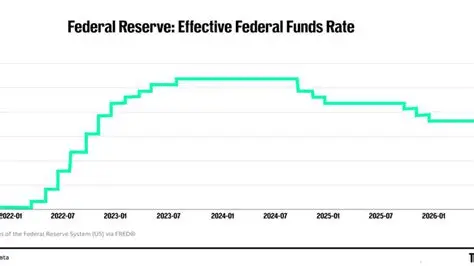
The Federal Reserve is expected to hike rates 25bp this Wednesday. The bond market has been on a tear, dragging mortgage rates along for the ride like an unwilling dance partner.
The 10-year Treasury yield is sitting at 4.99%, just a hair below the scary 5.00% mark. For context: back in late February, the 10-year was comfortably under 4.00%. That’s not just a 1-point difference in yield, it’s translated into more than a 1-point rise in actual mortgage rates.
Here’s the part nobody explains well: as rates climb, lenders get nervous about refinances, so any loan made now has a shorter expected life.
That uncertainty gets priced in as an extra spread on top of the Treasury yield, widening the gap between the 10-year and your actual mortgage rate.
In English: it’s not just what the 10-year is doing, it’s the gap between the 10-year and the mortgage rate that decides your payment, and right now, that gap isn’t doing anyone any favors.
Well, That Escalated Quickly
There’s a lot happening in the Middle East right now, and none of it is good news for your gas tank.
Saudi Arabia has shut down its East-West pipeline, the 7-million-barrel-a-day workaround built specifically to bypass the Strait of Hormuz, after a drone strike hit the line near Medina. So the backup plan for the backup plan just took itself offline. That’s not a great sign when you’re already down to Plan C.
The Houthis have seized Perim Island, a strategic chokepoint sitting right in the middle of the Bab el-Mandeb Strait, the “Gate of Tears” at the mouth of the Red Sea. Translation: they now have another lever to squeeze oil shipping, right as the Hormuz route was already struggling. The Red Sea and the Gulf are basically tag-teaming the global oil supply at this point.
My Take
The Fed is expected to raise rates because CPI inflation is running hot, but that inflation print is almost entirely a function of oil and diesel prices, with diesel now sitting at record highs. Diesel isn’t just a “gas at the pump” story either; it’s the backbone of trucking, shipping, farming, and manufacturing. When diesel spikes, everything that touches a truck gets more expensive.
Here’s the problem: raising rates doesn’t fix any of that. The economy is already slowing. This isn’t a “too much demand” inflation problem, it’s an oil supply problem, and the Fed doesn’t have a lever for pipelines getting droned or islands getting seized. Hiking rates into an oil-driven inflation spike is like turning up the AC because the house is on fire.
http://www.YourApplicationOnline.com
-
Every time you get up, you get Hit. So why get Up?

Bond Market Under Pressure
The bond market is struggling, and it’s not a minor pullback. Oil prices have broken above $100/barrel, adding fuel (literally) to inflation concerns. On top of that, the Treasury’s buyback announcement landed poorly with markets.
A Buyback in Name Only
Bessent announced the Treasury will buy back $6 billion at auction today. For context, that’s a fraction of past QE programs: $1.75 trillion in 2008, $766 billion in 2013, and $1.97 trillion in 2020. Those figures are in trillions, this latest move is in single digit billions.
Bessent also noted the Treasury is looking at $24 billion in buybacks through year-end. Given the scale of past interventions, it’s a modest gesture rather than a meaningful offset to current market pressure.
Producer Prices: A Preview, Not the Full Picture
The Producer Price Index for August showed inflation rising 0.4%, in line with estimates. However, this doesn’t yet capture the oil and gas price increases from mid-August. We’ll get a clearer read when September’s PCE report is released.
The bigger concern is the trend. Wholesale inflation is rising faster year-over-year. While there’s no direct, immediate correlation to consumer prices, wholesalers typically pass those costs along eventually.
Existing Home Sales Soften
Existing home sales fell 2%, while inventory rose 3% last month. This shift is visible both in the data and anecdotally, more listings, less urgency. The market is adjusting to higher rates and increased competition among sellers.
The Takeaway
Higher rates don’t have to mean you can’t find a good deal. A lower purchase price can still result in a manageable payment, even with rates where they are.
Now may be a good time to start looking.
http://www.YourApplicationOnline.com

-
Treasury Buyback could lower rates this week.

Remember QE? Good Times.
Back in the day, QE (Quantitative Easing) meant the Federal Reserve buying up US Treasuries like it was Black Friday at Best Buy. The result? Lower mortgage rates and happy homebuyers. Those were simpler times.
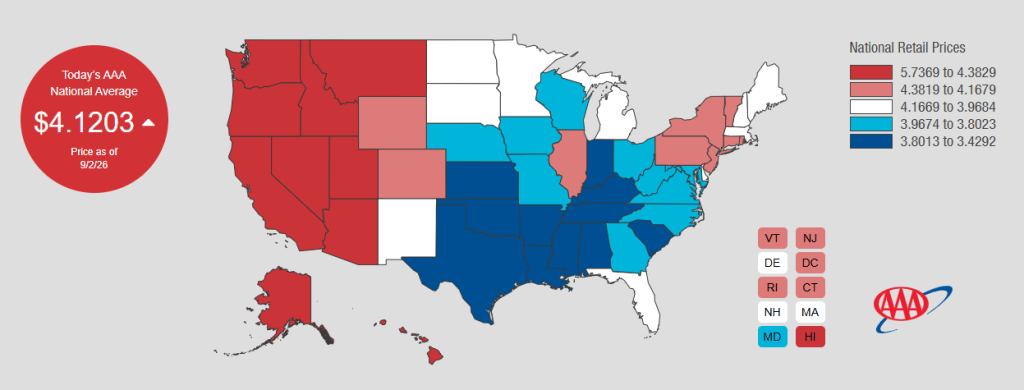
Fast forward to today, and oil is strutting around at $96/barrel, the highest we’ve seen since June. Naturally, the bond market did not take this well. Rates nationally have shot up to all-time highs, north of 6.75%. Bonds are basically the friend who overreacts to everything.
Jobs: Slow and Steady (Mostly Slow)
ADP says the economy cranked out 12,000 jobs per week over the last four weeks. That’s a slight bump from the prior four weeks’ 10,000, like going from a jog to a slightly faster job, putting us on pace for roughly 50,000 jobs this month. That’s weak, folks. We’re hoping the Fed is paying attention, but we’re not holding our breath.
Mortgage Applications: Buyers Said “Enough Waiting”
Despite rates sitting 36 basis points higher than this time last year, mortgage applications are up 6.85%. Turns out buyers and sellers are done waiting around for the mythical “perfect” rate or home value to magically appear. Spoiler alert: it’s not coming. Life moves on, deals get done, and people are starting to figure that out.
Ready to Join Them?
Stop waiting for perfect. Get pre-qualified today: www.YourApplicationOnline.com

-
There is a reason your Windshield is larger than your Rear View Mirror.

It’s hard to drive looking in the rear view mirror. Regardless of what’s behind us, it’s what’s in front of us that determines the direction we’re headed.
Oil & the Strait of Hormuz
Oil prices are trading just below $90/barrel, even though more than 17 million barrels passed through the Strait of Hormuz on Monday. That’s actually a good sign, it’s the most since the conflict began.
ADP Employment Report
ADP released its August Employment Report, showing just 38,000 jobs created, well below estimates of 53,000. The labor market continues to soften. Let’s break that number down.
All of the job gains came from Education/Health Services, which added 45,000 jobs. But hang on, if that’s the case, how did ADP land on a total of 38,000? Simple: every other sector combined lost 7,000 jobs.
The Fed has an unhealthy view of the job market. NY Fed President John Williams, a voting member, said this morning that he believes the “labor market is solid.” What?
Mortgage Applications
Mortgage application volume is flat, with rates holding at about 6.79% nationally. Refinances made up 42% of total transactions, with most of those being cash-out refis. This is a bit of a troubling sign, I remember the aftermath of the 2008 financial collapse. When debt consolidation starts ruling the roost, it’s the canary in the coal mine.
let’s get you pre-qualified http://www.YourApplicationOnline.com
-
JOLTS, Jolt Jobs Report. Feds, listen up, don’t be thinking rate hikes…
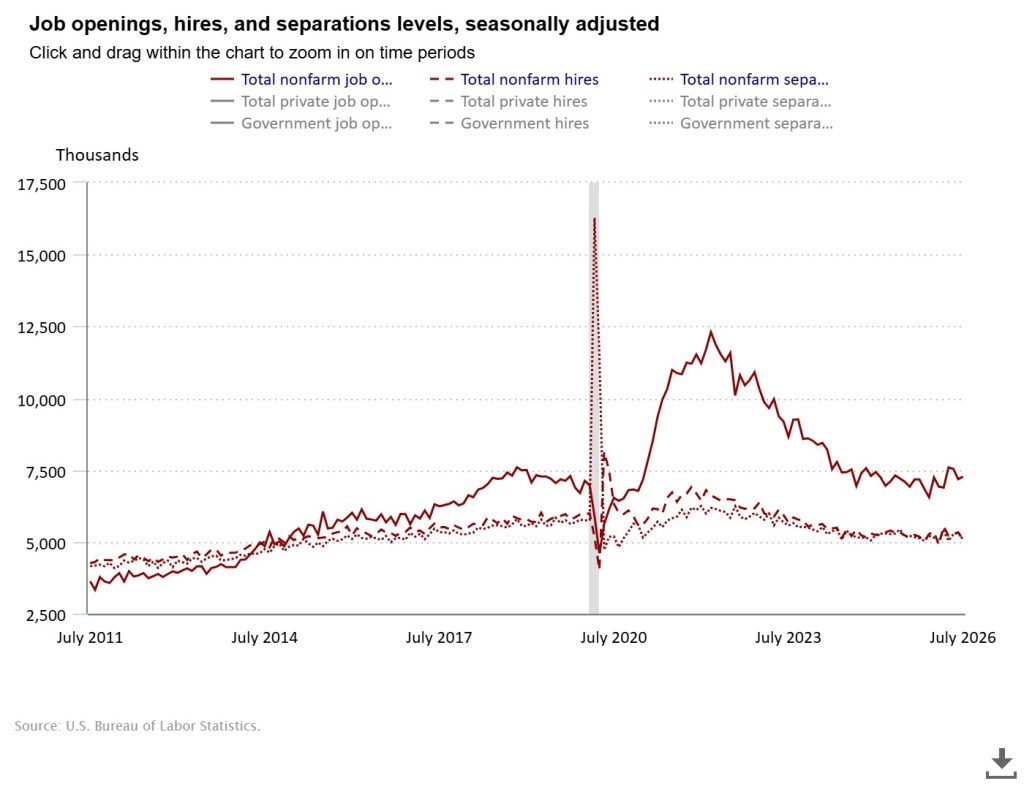
Job Openings and Labor Turnover (JOLTS) rose 89,000 to 7.27 million in July, but that follows a large downward revision of 177,000 in June.
Smoke and Mirrors: A recent report found that 1 in 5 job openings isn’t real. Some are posted to make a company look stronger; others are “aspirational,” posted in hopes of landing an all-star candidate for a position that doesn’t actually exist yet.
Here’s another wrinkle: job openings are counted at the state level. I’ll say that again, job openings are counted at the state level. That means the same job opening can be counted multiple times if it’s posted in different states.
The weakness in the labor market is real, and the Fed needs to wake up. Raising rates because “inflation” isn’t at 2% doesn’t fix anything, it just creates more inflation through higher costs for the consumer. To me, and this is just me talking… that’s crazy.
I really hoped Warsh got it. Apparently, he doesn’t.
Elevated rates are here to stay for the interim, so let’s get used to it and move on. Don’t wait around for a single event, rates dropping, home values falling, whatever it is, before you act. If you do, you’ll miss the real opportunity.
-
So Where do we go from here? Conflict sets off higher rates, Oil and likely rate hikes.

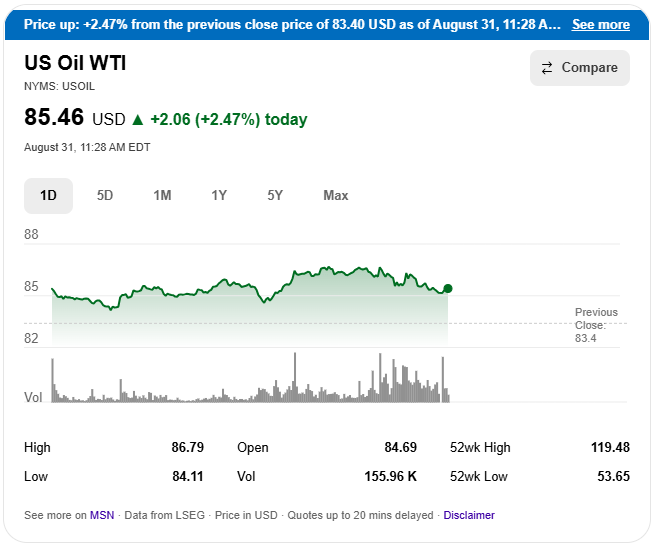
Just when it looked like a peace deal might be coming together, the US and Iran exchanged strikes over the weekend. Oil prices responded accordingly, with WTI up 3% to over $86/barrel.
This is pressuring stocks and bonds lower (i.e., pushing rates higher). Adding to the bond selloff, new Fed Chair Warsh struck a notably hawkish tone at his Jackson Hole speech, emphasizing rate hikes over cuts.
As if that weren’t enough, Ukraine attacked Russia’s second-largest oil refinery, dealing a significant blow to Russia’s refining capacity, reportedly disabling 43% of its capability.
Fannie Mae Home Price Expectations Survey
Fannie Mae released their Survey with the top 150 market economist forecasting nationwide home values over the next 5 years.
Modest predicted gains of 3% annually. With everything going on, homes may be the right place to park your money.
My take: Expect rates to stay elevated, with the Fed likely to raise rates at least twice more this year. It’s not what you want to hear, but it’s better to navigate with real information than wishful thinking.
http://www.YourApplicationOnline.com
-
Subscribe
Subscribed
Have a WordPress.com account? Log in now.

