-
Jobs Report Steller but Bonds slide on news.

There is an old saying. You can’t have your cake and eat it too.
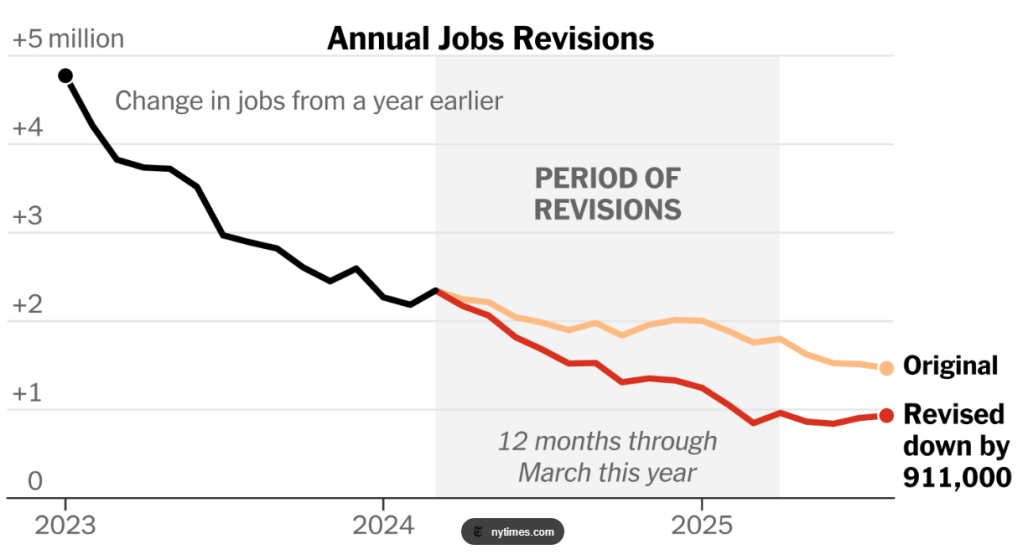
The Bureau of Labor and Statistics (BLS) released its may Jobs Report, showing $172,000 jobs added, Double the expectations of 85,000.
Bond market reacted as did rates. it moved lower but fortunately not too much.
Who creates this Jobs report?
The U.S. Bureau of Labor Statistics (BLS) is the federal government’s principal fact-finding agency for labor economics and statistics and has published the monthly Employment Situation (jobs report) for decades using transparent, documented survey methods and a public release calendar.
What’s important is its a survey not hard data. ADP is hard data with far more data points.
Do I trust BLS reports? Not really and its backed up by statistical analysis of revisions over time.
Time to get pre-qualified http://www.YourApplicationOnline.com
-
The World under New Fed Chair Warsh

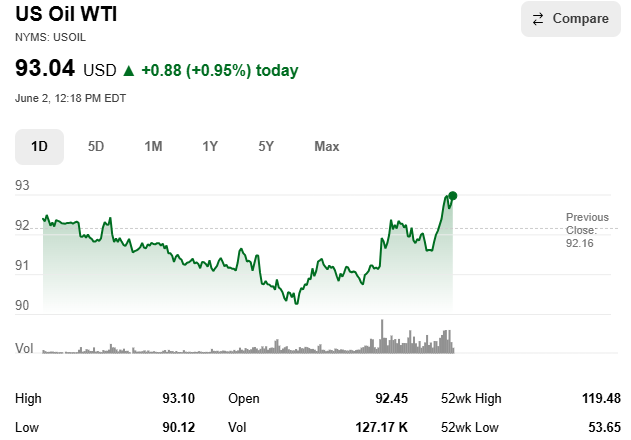
But first, some good news. Oil prices are down to $91.50 per barrel this morning, and Treasury yields are drifting lower as well. For mortgage rates, that’s generally a positive sign.
Markets appear encouraged that the U.S. proposal for a ceasefire and the reopening of the Strait of Hormuz may be back on track. While nothing is guaranteed, investors are clearly responding to the possibility of reduced geopolitical tension and a more stable energy market.
So what is new Fed Chair Kevin Warsh likely paying attention to?
One metric getting a lot of attention is the Dallas Fed’s Trimmed Mean Inflation rate. Unlike Core PCE, which can still be influenced by larger price swings, the Trimmed Mean attempts to remove the most extreme price movements on both the high and low ends to provide a smoother view of underlying inflation trends.
That measure is currently running around 2.3%, much closer to the Federal Reserve’s 2% inflation target than many of the headline inflation readings grabbing the news.
Translation: there is a credible argument for lower interest rates if policymakers focus on the underlying inflation trend rather than the more volatile headline numbers.
The challenge, of course, is that methodology matters. Depending on which inflation measure you emphasize, the economy can look either very close to the Fed’s target or still well above it. That’s the debate the market is watching closely.
Time to get Pre-Qualified http://www.YourApplicationOnline.com
-
Iran, Israel, Lebanon and the US this morning. Oil and rates respond.

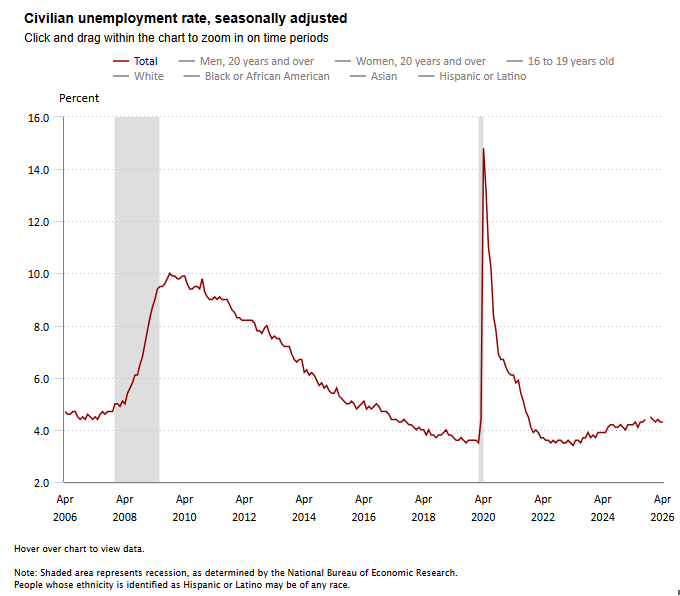
Markets are waking up to a rough start this morning as oil prices surge nearly 5% following reports that Iran has halted negotiations amid the expanded ground assault in Lebanon.
Adding to the tension, the U.S. and Iran exchanged strikes over the weekend, reminding investors just how fragile the current situation remains. While optimism for a diplomatic resolution still exists, it’s hanging by a thread.
The bond market is reacting accordingly. Higher oil prices increase inflation concerns, and inflation is never a friend to lower interest rates.
Adding another layer to the story, Exxon recently warned that oil prices could move significantly higher, potentially reaching $150 per barrel. Thus far, global inventories have helped absorb much of the supply shock.
As those inventories are drawn down, the cushion becomes smaller and upward pressure on prices grows.
For now, the market remains focused on one thing: stability. Until there is a clear path toward de-escalation and energy prices begin to normalize, volatility in stocks, bonds, and mortgage rates is likely to remain elevated.
Jobs reports all week. lets see what happens and if we can hold onto all the gains from the last week.
http://www.YourApplicationOnline.com
-
The Balancing act of negotiating Disappointment and Softer GDP and PCE.

Bear with me for a moment:
With every good comes some bad. With every high, a low. We only recognize light because we have seen darkness, and we only appreciate the climb because we have felt the fall. One gives meaning to the other.
Stocks are lower this morning, oil prices are ticking a bit higher, but Mortgage Bonds are slightly positive after softer-than-expected economic data helped stabilize the bond market.
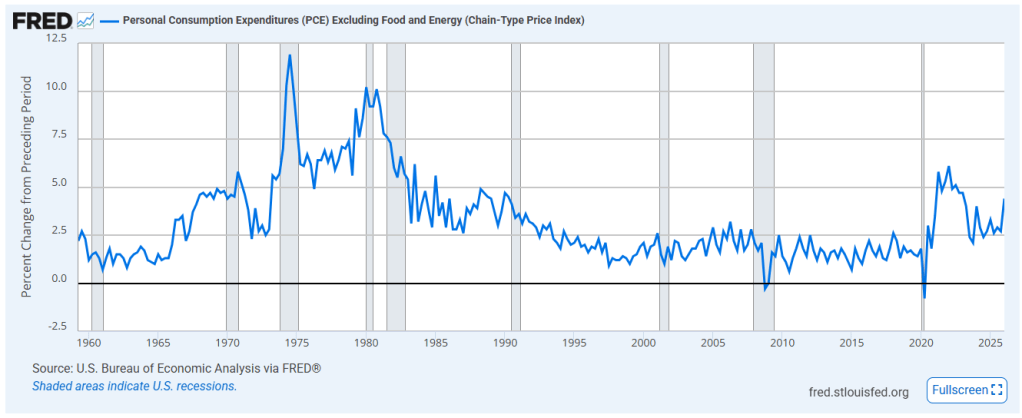
On the heels of more disappointment surrounding the Iran/U.S. peace discussions, markets were looking for something positive, and they found it in weaker GDP growth figures and cooler monthly PCE inflation readings.
That combination helped offset some of the pressure coming from rising oil prices and ongoing geopolitical uncertainty.
The market is essentially stuck between two competing forces right now:
- Higher oil prices and global tension pushing inflation fears higher
- Slower economic growth and softer inflation data helping bonds recover
For mortgage rates, that means continued volatility. One headline can move the market quickly in either direction.
Bottom line: the bond market is still searching for stability while trying to determine whether inflation or slowing growth becomes the bigger story moving forward.
http://www.YourApplicationOnline.com
-
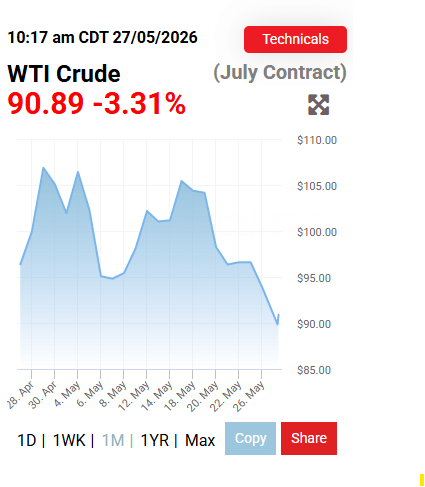
Under $90/barrel Yeah. Funny how quickly market and expectations adjust.

Two months ago, if someone said oil would be sitting just under $90 a barrel, the reaction would have been a collective gasp of dread.
Funny how quickly things change.
Now the market is practically celebrating oil at $90 a barrel.
Bottom line, the market wants stability. Even a small hint that the Strait could reopen within the next 30 days is enough to give investors some optimism. Let’s cross our fingers and hope cooler heads prevail.
In other news, the upcoming Personal Consumption Expenditures (PCE) inflation report is expected to show headline inflation rising from 3.5% to 3.8% year over year. Under normal circumstances, that would likely pressure both bonds and mortgage rates higher.
But right now, geopolitics and oil are driving the bus. As long as there are no major negative developments surrounding the U.S./Iran peace talks, the market may be willing to look past a hotter inflation reading, at least temporarily.
http://www.YourApplicationOnline.com
-
Peace? Uncertainty and some Optimism helps Bond Markets Globally

Oil prices and Treasury yields are lower this morning as optimism builds around a potential U.S./Iran peace deal.
At this point, markets are grasping not at straws, but at any dangling rope or piece of twine that appears. The world collectively wants this conflict to end preferably yesterday.
For now, markets are reacting positively to even the possibility of progress, though investors remain cautious after several false starts and headline reversals along the way.
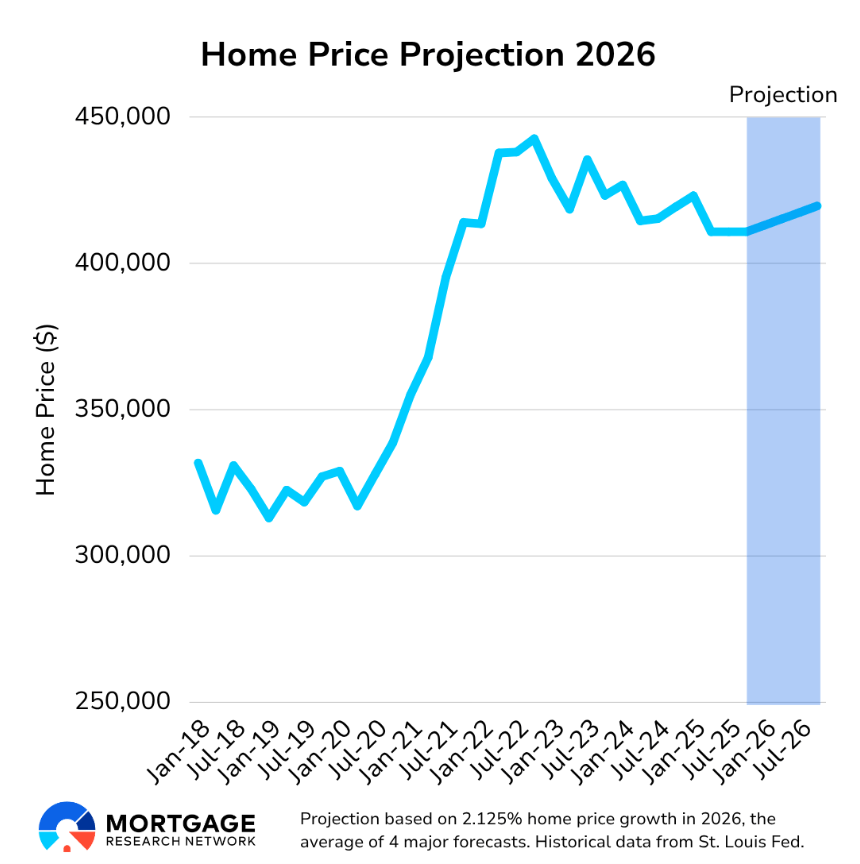
Housing Appreciation Data showed decent gains in March, but digging deeper into the numbers reveals a relatively flat overall reading beneath the surface.
That is not entirely unexpected given the current housing market, higher rate environment, affordability pressures, and broader global uncertainty. On paper the market still appears stable, but momentum has clearly slowed compared to prior years.
Time to get pre-qualified, Soft credit pull.
http://www.YourApplicationOnline.com
-
Pressure Building on both sides and Memorial Day Ultimate sacrifice for our freedom.

There is significant pressure building between Iran and the U.S. At this point, nobody truly wins in these situations, and over time we all end up paying the price one way or another, whether through higher oil prices, inflation, market volatility, or broader economic uncertainty.
The bond market and oil prices continue to modestly improve. We’ll take that for now, but markets would likely improve more substantially once an official compromise is reached.
That said, we’ve seen plenty of head fakes over the last few months, so there’s still skepticism around whether anything permanent ultimately materializes. For now, there are ongoing discussions surrounding a potential interim deal, and markets appear cautiously optimistic.
This Memorial Day, we remember and honor the brave men and women who made the ultimate sacrifice for our freedom. Grateful today and every day for those who served and gave everything for this country.
http://www.YourApplicationOnline.com

-
Deal, No-Deal, Deal, No-Deal. Peace deal fades as Oil prices rise.

Oil prices and bond yields are moving higher again this morning as optimism surrounding a potential Iran-U.S. peace deal continues to fade. Markets are reacting to uncertainty, and uncertainty is rarely friendly to interest rates.
The Fed hawks are also back in the conversation, with growing speculation that another rate hike could still be on the table as inflation remains stubbornly above 3%. New Fed President Kevin Warsh added fuel to that discussion as markets continue trying to price in the next move.
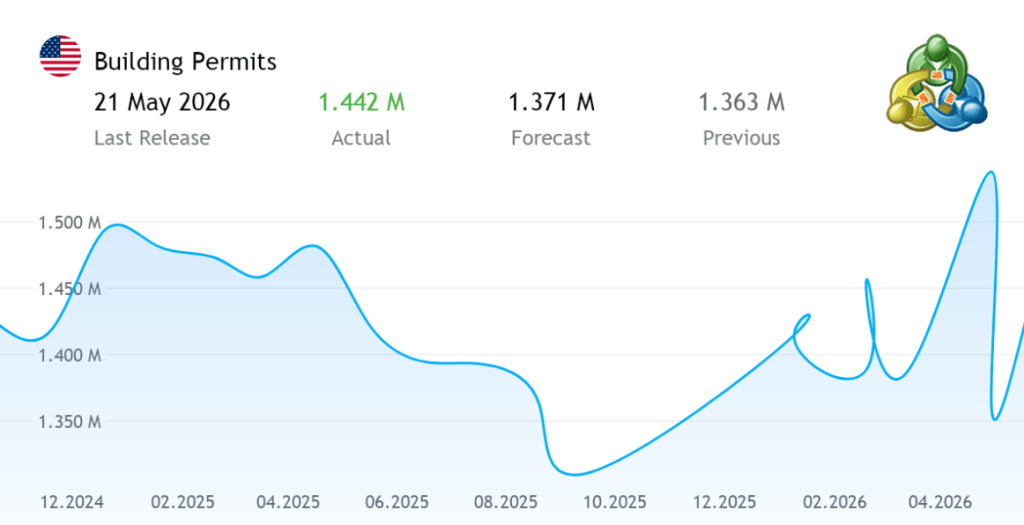
On the other side of the economy, housing data came in stronger than expected. Housing permits rose 5.8% in April while housing starts slipped only slightly. Both reports beat expectations and continue to reinforce the point that, regardless of rates, life keeps moving forward.
People still relocate, families grow, jobs change, and homes continue to be bought and sold.
Another interesting piece of the inflation story: rent growth remains relatively tame, rising only 1.3% year over year. That’s a meaningful slowdown compared to the sharp rental increases we saw over the last few years.
So where do we go from here?
We do what markets, homeowners, and buyers always do; we adjust, adapt, and plow forward to live another day.
http://www.YourApplicationOnline.com
-
Home Sales Up 1.4% despite higher rates. Life moves on regardless.

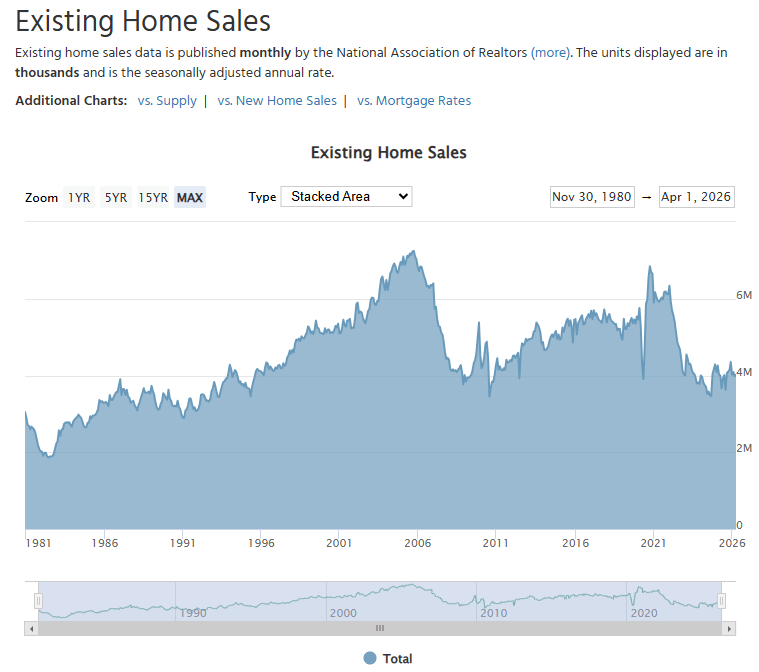
Pending Home Sales, which measure signed contracts on existing homes, rose 1.4% in April despite higher interest rates. March was also revised higher to 1.7%.
So what’s going on?
First, real estate data is often measured against the previous 12-month period. If last year’s numbers were weak, even modest improvement can show as growth.
But more importantly, life keeps moving forward regardless of headlines or mortgage rates.
People don’t just buy and sell homes because rates are low. Life events drive housing decisions far more than the daily market cycle. Divorce, death, marriage, growing families, job relocations, retirement, downsizing, those realities continue no matter where interest rates are sitting.
That’s why housing never completely stops. Buyers and sellers will always have motivations beyond the day-to-day market noise.
The market may slow, adjust, or shift strategies, but life events continue to create demand.
Let’s get you pre-approved http://www.YourApplicationOnline.com
-
The Pressure is building, Oil prices, Stock market and Bonds. Something has to give.

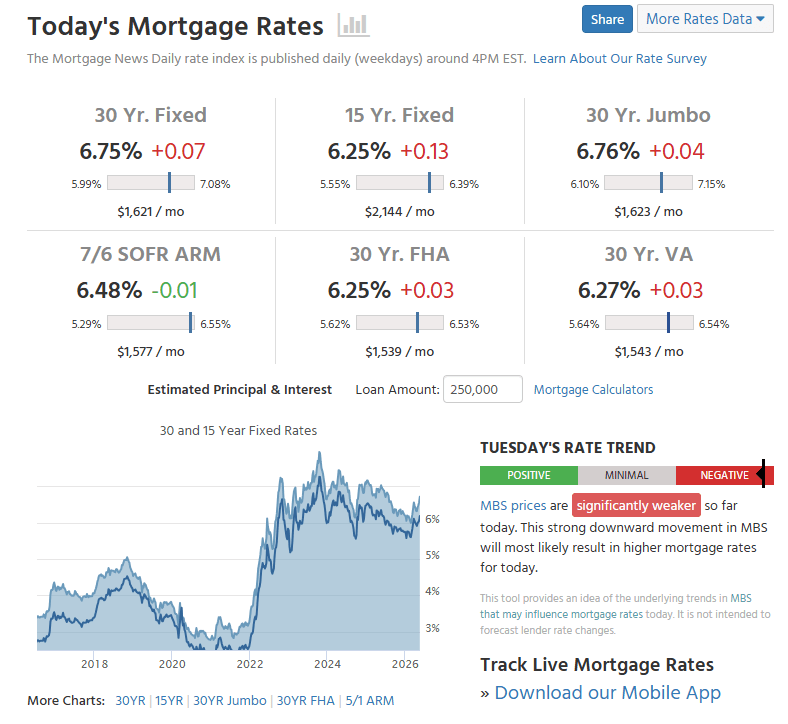
Oil prices are higher this morning, with WTI trading around $109/barrel. The stock market is lower, and Mortgage Bonds are also down sharply to start the day. Meanwhile, the 10-year Treasury yield continues to push higher, now trading above 4.65%.
As a general rule of thumb, adding roughly 2% to the 10-year Treasury yield puts us close to the current national average mortgage rate environment, which is hovering around 6.75%.
The combination of higher interest rates and rising home values has continued to create a “lock-in effect” for many homeowners. In addition, outdated tax rules are not helping encourage inventory movement.
Currently, homeowners who have lived in their primary residence for 2 out of the last 5 years may qualify for a capital gains exclusion of up to $250,000 for single filers and $500,000 for married couples filing jointly.
Those exclusion limits have not been updated since 1997, despite home values increasing more than 2.5x in many markets over that same period.
There are proposals being discussed that would potentially double those exclusion limits. At present, approximately 15% of homeowners are estimated to have gains above the current thresholds, which becomes yet another reason many homeowners choose not to sell.
Not trying to be Debbie Downer here, but it’s important to take an eyes-wide-open approach.
http://www.YourApplicationOnline.com
-
Subscribe
Subscribed
Have a WordPress.com account? Log in now.

