-
Initial Jobless Claims Rose for the first time.
Initial Jobless Claims, which measures an individual’s filing for unemployment benefits for the first time, opposed to Continuing Claims.
These two reports show what we already know is happening. Employers are holding onto their workers. The Labor picture has been slowing down as seen by Employers hiring less.
Those Employers are not trimming jobs, just hiring less. Tomorrow is the big Jobs Report data. What we expect to see is job growth miss the expectation which would lead to a positive reaction in the Bond market.
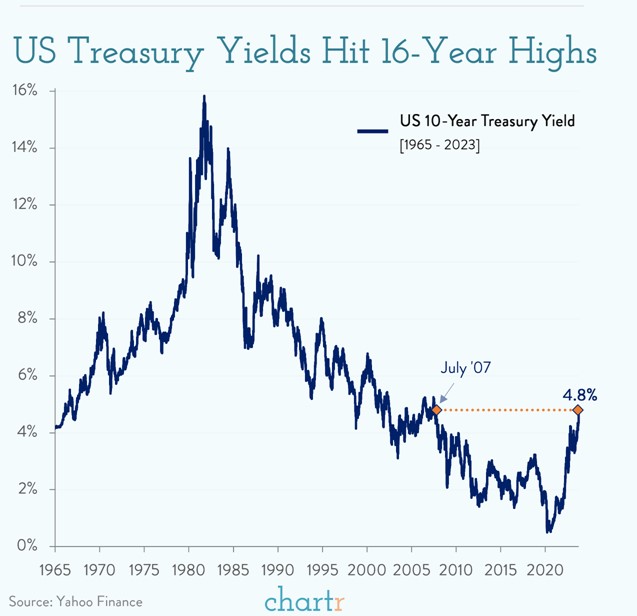
Speaking of the bond market, I’m guessing you have noticed rates have gone up quite a bit the last few weeks. Treasury Yields at their highest since July 2007.
-
The Fog of War – Data that is…
As I mentioned yesterday the JOLTS report showed better than anticipated employment openings, Hiring rate and Quit rate.
But now the ADP Employment report for September is showing only 89,000 jobs created much weaker than the 153,000 expected. August had 177,000 jobs created. Far different than the JOLTS report.
Most of the jobs came from the services sector. There was a decline in professional/business services.
Nela Richardson from ADP said that we are seeing a steepening decline in jobs this month.60% of people on payrolls are hourly workers, and hourly wages have been stuck at $17/hour since February.
I say this because there are analysts out there that are equating higher wages fueling inflation. This is not the case.
The JOLTS report is self reporting and only 32% of requested companies responded. Its the Fog of War when trying to grasp at every bit of data to produce a coherent picture of what is going on.
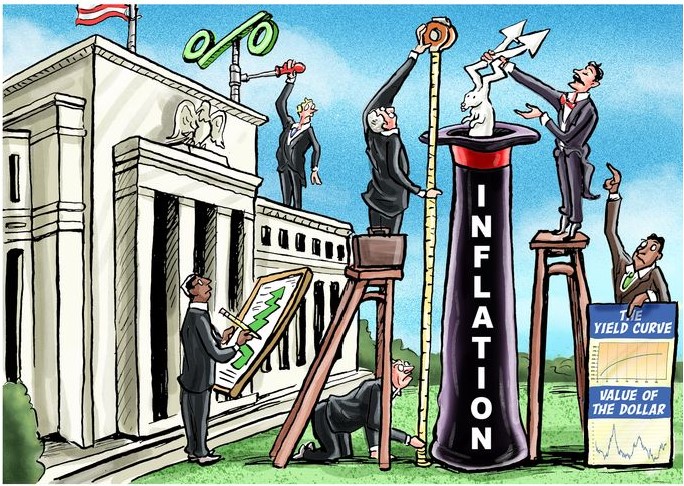
Inflation and the Fog of War -WSJ
-
What is a JOLTS report you may ask….
The Job Openings and Labor Turnover Survey (JOLTS). Here is why it’s important and another datapoint.
This report tells us the number of job openings each month, how many workers were hired and how many quit their job. Additionally how many were laid off and how many experienced other separations.
Here are the numbers:
- Job openings in August, rose from 8.92M to 9.61M. Stronger than expected
- Hiring rate stayed the same at 3.7%.
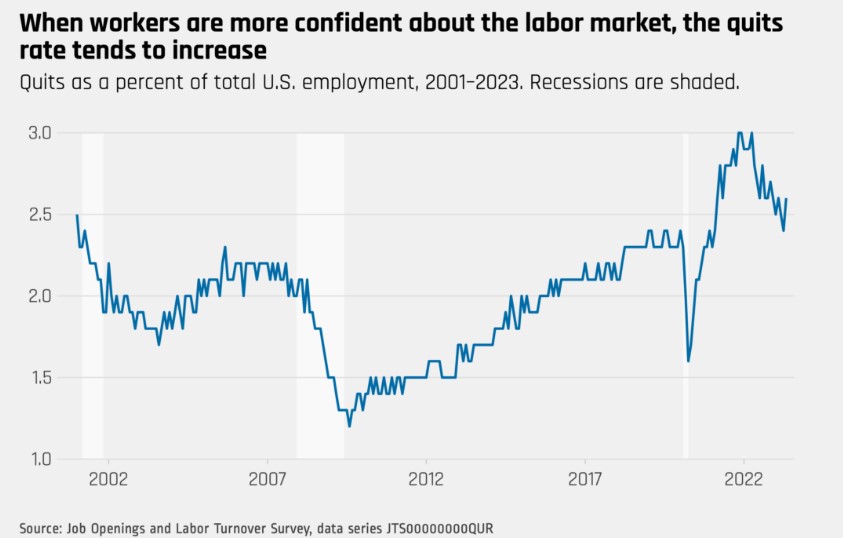
- Quit rate is 2.3% unchanged. Lowest since January 2021
- Job openings down 6% Y/Y. Indeed reported September showing job openings down 15% Y/Y.
When workers are more confident about the labor market, the quits rate tends to increase.
One of the challenges is the Feds are still talking rate increases. The data is telling us the economy is slowing down.
-
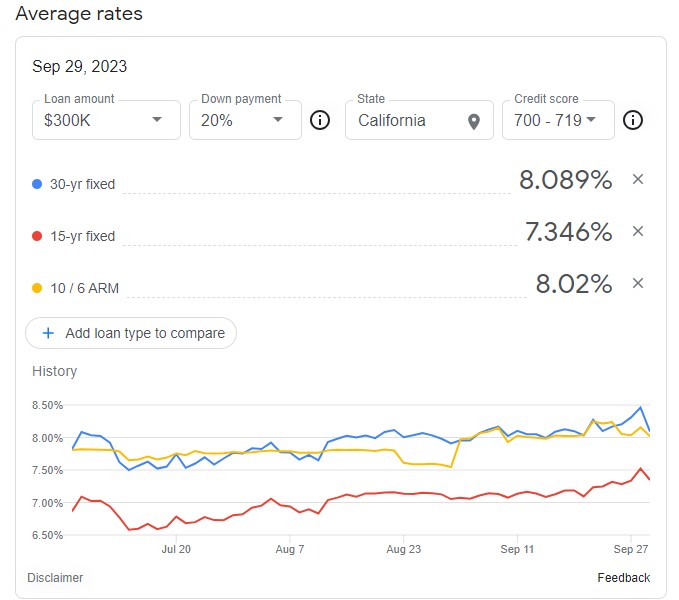
Average Mortgage rate 8.089% seriously… but there is a positive outlook
The 10-year bond currently stands at 4.676%, according to UBS investment banking company. They anticipate a decline in both 10-year and long-duration bonds, possibly reaching 3.5% and even as low as 2.75% in 2024.This strategy takes a long-term view, considering the upward trend in home values. Despite the relatively high rates, the substantial increase in home appreciation outweighs the impact of the higher payments.
Difference in house payment 30y fixed Principle and Interest only. $500k loan using average national rates.
8.089% $3,699 Current Average National rates
4.500% $2,533 Projected Average National rates late 2024
-
How will the Government Shutdown affect Mortgages and Rates
Here is the breakdown:
Fannie Mae and Freddie Mac will likely still continue processing mortgage loan applications but federal employees in the middle of buying a home may not be able to have their income verified.
IRS processes transcripts for income verification and social security verification
FHA, VA and Rural Housing USDA, Reverse Mortgages will become backlogged with minimal staff.
Will it affect rates? There is a slight chance rates will go up due to uncertainty. The Buyers of the bond, which are mortgages that are bundled together and sold so lenders can free up funding to make new loans, are likely to want higher mortgage rates to compensate them for the unpredictability in the market.
But those rates are likely to come down once the government reopens.
The overall impact is more of an inconvenience of time and funding than a complete meltdown.
-
Consumer Confidence is perplexing
“Consumer confidence fell again in September 2023, marking two consecutive months of decline,” said Dana Peterson, Chief Economist at The Conference Board. “September’s disappointing headline number reflected another decline in the Expectations Index, as the Present Situation Index was little changed. Write-in responses showed that consumers continued to be preoccupied with rising prices in general, and for groceries and gasoline in particular. Consumers also expressed concerns about the political situation and higher interest rates. The decline in consumer confidence was evident across all age groups, and notably among consumers with household incomes of $50,000 or more.”
We are all in this together and there is light at the end of the tunnel.

-
Feds are Sticking to their guns on 2% inflation target.
I’m in Boston MA this week so this will be a quick post.
Chicago Fed Pres, Austan Goolsbee stated this morning that the risk of inflation remains higher than they would like.
Bess Freedman CEO from Brown Harris Stevens stated the obvious or what I have stated for the last year, that demand remains high and no inventory. Once rates come down, More inventory will come onto the market and home values will decline.
Except the last part. There is so much pent up demand for homes that even if we doubled or tripled the inventory we still may not have enough. Home values may adjust but The consensus is not meaningful.
We are headed for a perfect storm in a very good way. Rates will drop with inflation but when we can’t say. Get yourself ready and call us or your lender to get pre-approved with a mortgage checkup.

-
It must be easier was is to make a living but not this much fun…
That was deliberately confusing and Chat GPT agreed, but the point is there.
The Mortgage and Real Estate industry has been put on its head with everyone thinking if we just walk a little further, just over that hill the skies will open.
The reality is the housing market is stuck. Stuck with home owners afraid to let go of their low interest rate mortgages, afraid of what they can or can’t get after they decide to sell and afraid to do the wrong thing.
Not that long ago we went through the 2008 global financial crisis. The same buyers who lost homes 14 years ago and purchased in the last 5 years, don’t want to live through that again and will hold onto their homes even tighter.
Jerome Powell made it clear that 2024 looks to be the same as 2023. Like it or hate it, it is what it is. Get busy or stay on the porch, you decide.

-
Thank you FED … NOT
We continue to see interest rates rise the last two weeks and Jerome Powell, our fearless Fed Chair, did not disappoint.
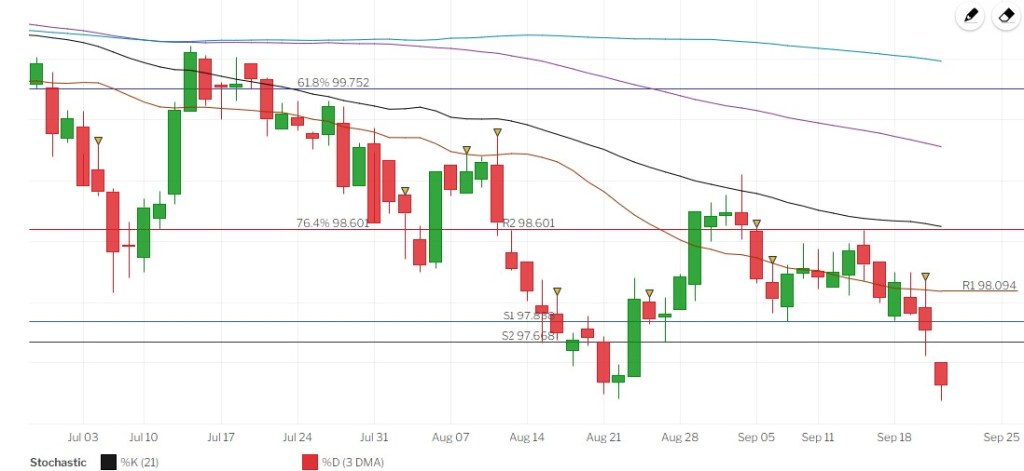
Though he did not raise the Fed Rate he did state that the rates will remain high for the foreseeable future meaning deep into 2024.What you are seeing below is the UMBS 30YR. This is the 30year Uniform Mortgage Backed Securities. They are passthrough securities, representing an undivided interest in a pool of residential mortgages.
To make it more clear, Down is Bad – higher rates. But as you can see it’s cyclical so we are not falling off a cliff, I hope. To put this into perspective, the top compared to the bottom is about a point and a half of interest rate.
-
What is a FED Dots Plot chart and why you should care.
The Fed Dots Plot is a chart that shows you where each FOMC – Fed Open Market Committee member thinks interest rates will be by the end of the current year, two consecutive years after, and the more ambiguous “longer run.” Each “dot” represents a member’s individual view.
The graph below is the March and June Plot. Later today we will see the FOMC members projections.
What you are seeing is a strong consensus that the Fed rate will drop in 2024.
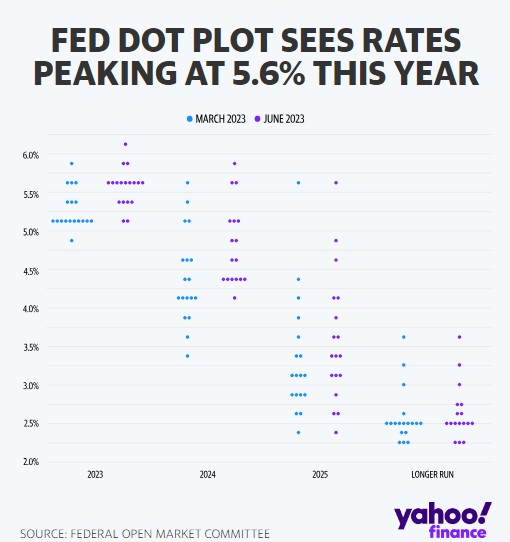
We have new projections on GDP, the unemployment rate, PCE Inflation and the new Dots Plot.
Look for Tomorrows post for mor information.
Are you Purchasing or refinancing? happy to help.
-
Subscribe
Subscribed
Have a WordPress.com account? Log in now.

