-
Are you writing this down because I don’t have a crayon.
Personal Consumption Expenditures (PCE) are coming out this Friday. It’s the Fed’s favorite measure of inflation.
And speaking of inflation, one of our move Dovish Fed Presidents Austan Goolsbee of Friday said that we never want to overreact to one reading, but we have had three months of readings and inflation is just not budging.
How long do we sit back and wait for the right situation to happen before we make our move? There will never be a perfect time. There will never be a wrong time. The world moves forward regardless.
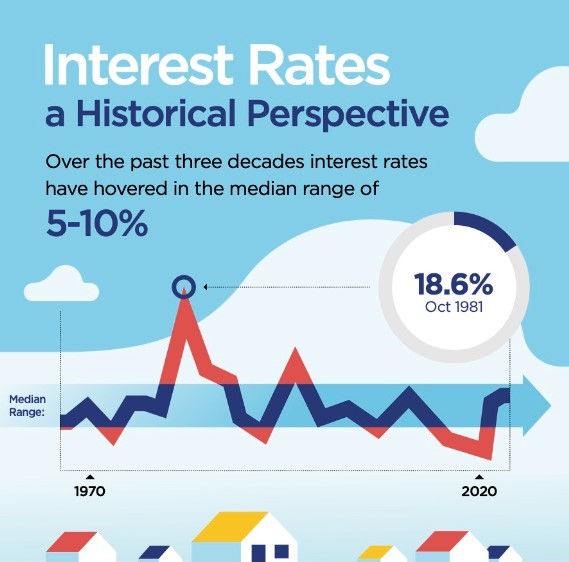
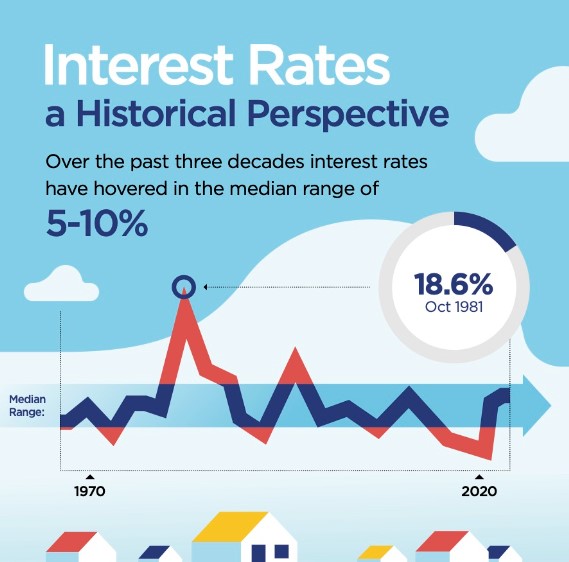
I used this graph last week, but it’s worth repeating: Rates are high, from the hindsight perspective of two years.
-
If you are Coasting, you are going down hill.-Paul K.
Mid week we had a bit of a rally in the bond market which started to erase the higher yields/mortgage rate movement. But like any good news, we have a Debbie Downer at the party.
Yesterday, New York Fed President John Williams dampened the spirits. He stated that he wouldn’t rule out further rate hikes until the data showed lower inflation figures.
This announcement prompted a sell-off in bonds. Think of it as Quantitative Tightening rather than Quantitative Easing (buying bonds/securities to lower rates).
Next week, we’ll see New Home Sales, Mortgage Applications, Durable Goods Orders, Jobless Claims, and Friday’s Personal Consumption Expenditures (PCE).
The bottom line is that there’s a growing tendency toward lower yields, so the prudent approach is to exercise patience.
Regarding the headline; if you’re simply coasting along without putting in effort or actively working towards something, you’re likely to experience a decline or negative consequences.

-
Nothing has changed, it’s just your desire for something different. – Michelle K.
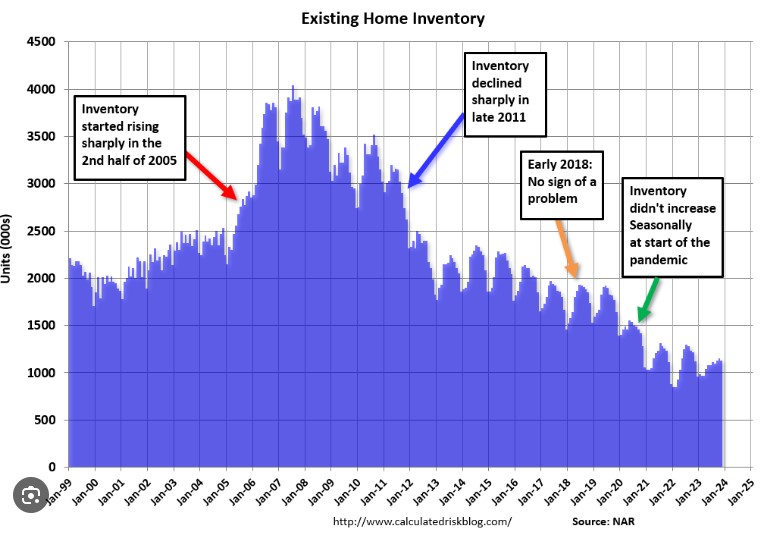
In the context of the housing market and economic conditions, there are concerns such as low inventory, high interest rates, or stagnating economic growth. These factors have been persistent and are not fundamentally changing.
The feeling of frustration or urgency to see improvements may stem from a desire for conditions to be more favorable rather than any real shifts in the circumstances.
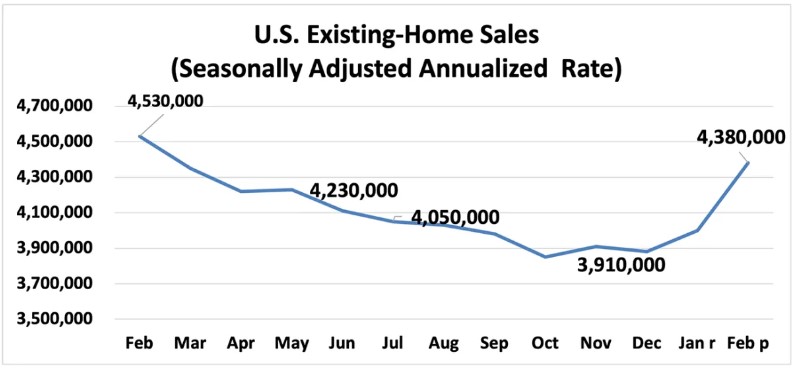
What’s our next step? We keep moving forward. Life doesn’t pause to accommodate a perfect scenario. Waiting for ideal conditions means missing out while life keeps moving.Inventory increased 4.7% month/month. We now have a 3.2 month supply. 4.6 months is considered normal.
Median home price rose to $393,500, up 4.8% from last year.
First time home buyers account for 32% of sales, up quite sharply from 26%. Cash buyers are 20% of sales down from 32%. Investors made up 15%, down from 21%.
29% of homes sold over list price up from 20% in February.
Spring has sprung and the market is getting hot.
-
That speed bump ahead is just an Illusion. Don’t borrow trouble from the Future.
Mortgage applications have shown resilience despite higher interest rates, with a 5% increase from the previous week. However, they are slightly down compared to the same period last year.Refinancing activity has surged, up 11% even with rates being 0.75% higher than last year. This suggests that despite the higher costs, homeowners are still seeking to refinance their mortgages, likely due to various factors such as reducing monthly payments or accessing equity.
Federal Reserve Chair Jerome Powell’s recent remarks on U.S.-Canadian economic relations indicated a concern about the stagnation in reaching the Fed’s 2% target and a decrease in confidence. This sentiment could impact the outlook for future rate cuts, potentially leading to a more cautious approach by the Fed.
The sentiment expressed about the current state of the housing market reflects a broader trend observed in the industry. Low inventory levels coupled with higher interest rates are causing many agents and borrowers to adopt a cautious stance, resulting in a sort of holding pattern. While there is an expectation that these challenges will eventually subside, the process may be slower than desired, creating uncertainty in the market.
-
Builders feeling Confident. Highest level in 9 months.
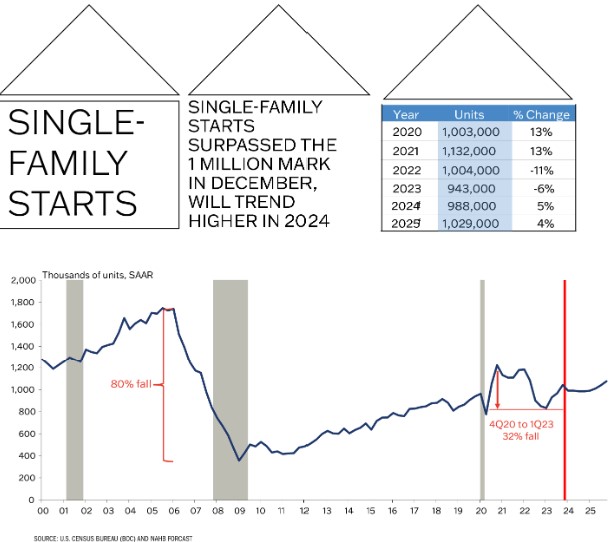
The NAHB Housing Market Index, which measures builder confidence, has held steady at 51. Despite this overall stability, there have been some fluctuations in specific aspects of the market. Current sales saw a modest increase of 1 point, reaching 57, indicating ongoing demand. However, there was a slight decrease in Future Expectations, dropping by 2 points to 60, suggesting some cautiousness about future market conditions. Buyer traffic also saw a slight uptick of 1 point, reaching 35.The NAHB index is derived from a monthly survey of NAHB members and serves as a barometer for the single-family housing market. It provides valuable insights into market conditions and sentiment among builders.
Despite fluctuations in certain indicators, builders generally remain confident. They are showing restraint in cutting home prices compared to previous months and are also reducing incentives, indicating a level of stability in the market.
While Single-Family permits experienced a 6% decline, the year-over-year data shows a significant increase of 17.4%, suggesting long-term growth in the housing market.
Overall, the housing market continues to be supported by strong demand and limited inventory. This scarcity of available homes is contributing to sustained home prices.
-
Why do we keep spending money?
Retail sales for March rose 0.7% up from the expected 0.3%. February was revised upward from 0.6% to 0.9%.
When we strip out Autos and gas, sales rose 1%.
While these numbers suggest a resilient consumer, there may be signs of pressure and a potential slowdown in spending, though only time will confirm this.
Bonds sold off sharply after this release meaning a hit to the rates. A reminder about the FEDs.
Quantitative Tightening – (QT) is the selling of Bonds/Securities from their balance sheet.
The FEDs have indicated Quantitative Easing – (QE) or the buying of Bonds/Securities.
-
The Sky is not Falling. Keep Calm and Carry on.
The Personal Consumption Index (PPI), which measures wholesale and producer inflation, rose by 0.2%, falling below expectations. However, food prices saw a notable increase of 0.8% month-over-month, which is lower than February’s 1.1% hike.
The Core rate, which excludes food and energy prices, rose within expectations.
It’s important to avoid knee-jerk reactions in response to these fluctuations. Instead of watching dogs wagging their tails to predict where things are going, it’s wiser to follow the footprints.
In the background over the last two plus years, the Fed has been engaged in Quantitative Tightening, meaning they’ve been gradually selling off their balance sheets, including Treasuries and Mortgage-Backed Securities, for years now.
Now, they’re considering Quantitative Easing, which is essentially the reverse. This is a strategy previously employed post-2008 financial crisis and more recently during the 2020 pandemic.
When the Fed purchases Securities and Mortgage-Backed Securities, it typically leads to a drop in rates.
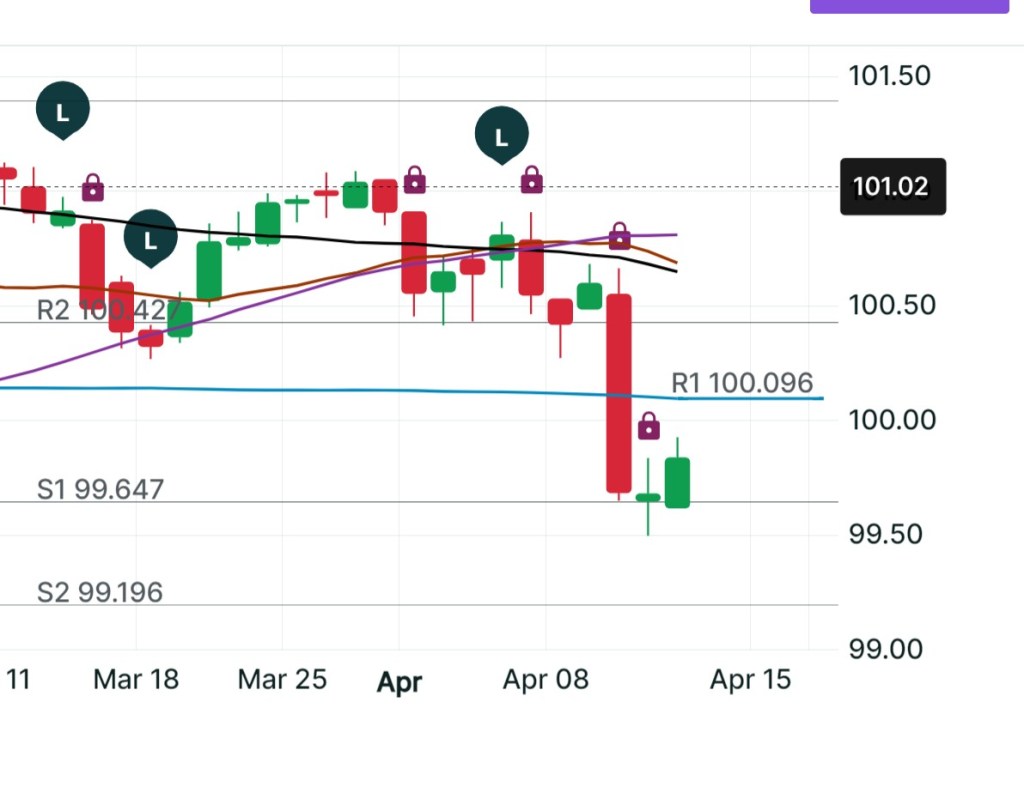
Wednesday as evident in the graph below, was tough on rates. Down is lower rates. This represents about a 3/8 increase in rates. Since then we are starting to recover.
-
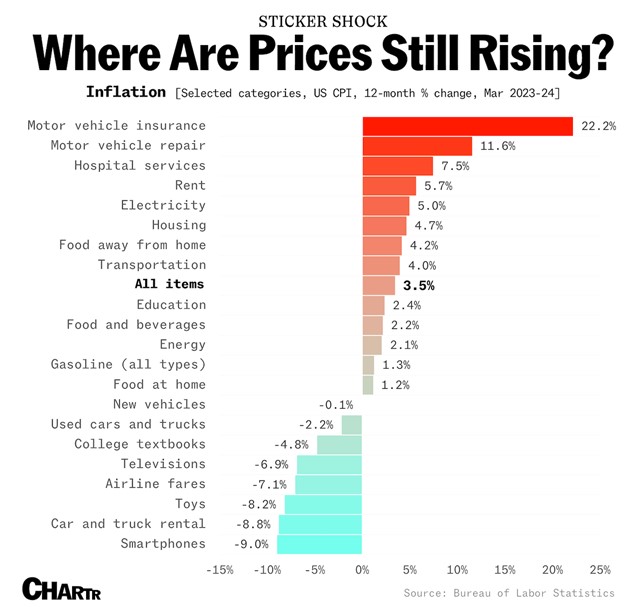
So where do we go from here? CPI 3.5% expected 3.4%
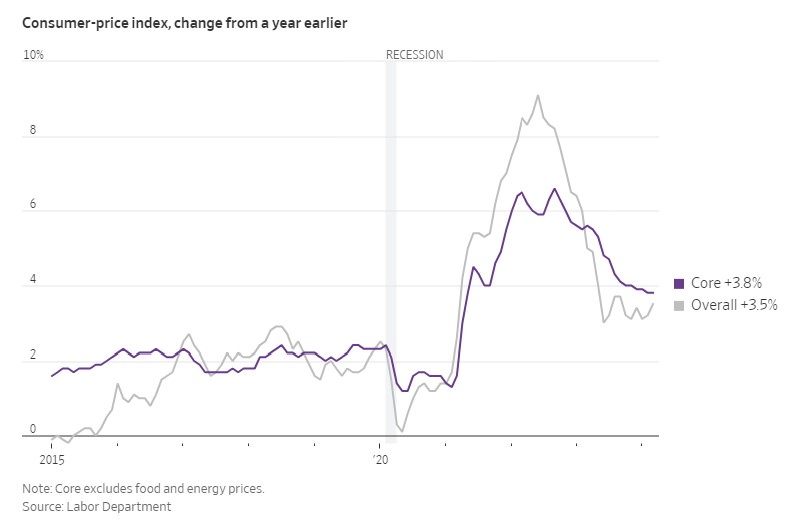
The Consumer Price Index (CPI) rose by 0.4% in March and 3.5% year over year, slightly exceeding our expectations of 0.3% and 3.4%, respectively.
The larger concern arises from the fact that both January and February also experienced higher-than-anticipated increases.
The bottom line is that the Federal Reserve (FEDs) is not pleased. Additionally, the differential between the 2-year and 10-year bond inverted yield curve is troubling. An inverted yield curve means that shorter-term yields are higher, which, upon reflection, doesn’t seem logical.
In theory, holding money for a longer period should yield higher returns.
Let’s all take a deep breath and review the graph below. Inflation is down significantly. It’s just not where we or the Federal Reserve wants it.
-
Sometimes the Problem is the solution you have been avoiding.
It suggests that the solution to a problem may actually lie within the problem itself, and by addressing the problem directly, you may find the solution you have been avoiding.
The Bond Market has sold off in the last few weeks, putting pressure on mortgage rates. Consequently, the markets have less confidence in a 25-basis-point rate cut in June.
Inflation is stubborn; it’s not our friend and is effectively holding everyone back. We anticipate inflation to increase from 3.2% to 3.4%.
Shelter costs, which make up 45% of the Core CPI numbers, are not slowing down or have stalled.
The problem is that we keep waiting for the next turn to make a decision, but that turn just looks like the previous one. Rates are a problem because we are making them our problem.
I may not be telling you what you want to hear but sometimes the truth hurts a bit.
-
A funny thing happened on the way to the Forum.
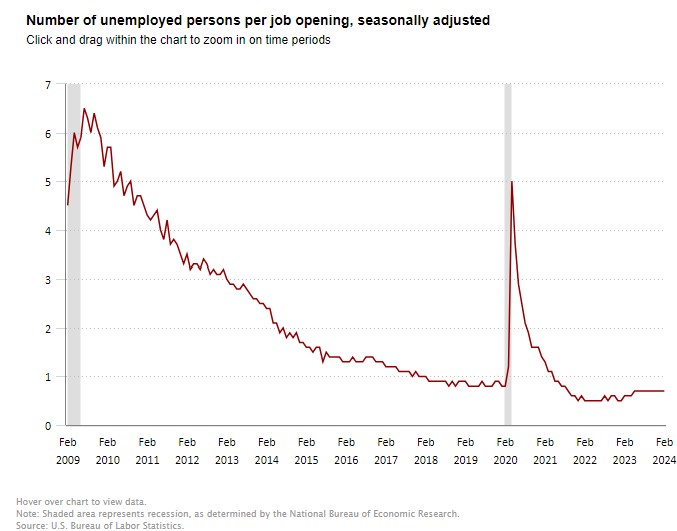
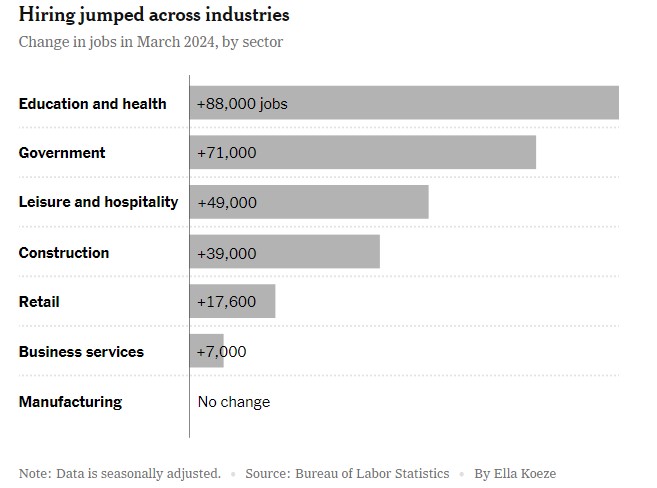
The jobs report came in much hotter than expected, but there is a silver lining. When there are as many job openings as there are job seekers, that equilibrium results in a net zero gain on inflation and no wage pressure.
Think of it this way: if you were looking for a job and received five offers, you could negotiate higher pay or better benefits.
Consider these two real-life scenarios: if you are competing with 100 other candidates for the same job, good luck negotiating anything.
However, if employers are eager to fill job openings and need to attract more candidates, what better way to do so than by increasing salary or benefits? This can be an inflationary component.
the Unemployment rate dropped from 3.9% to 3.8%. Our gut is thinking the Feds are going to freak out. Maybe not considering the above.
-
Subscribe
Subscribed
Have a WordPress.com account? Log in now.

