-
Contraction of Job openings and more Oil Production
The recent JOLTS report revealed a decline in job openings, particularly noticeable in the Leisure and Hospitality sector with a decrease of 109,000 openings—a sector that had previously shown robust job growth.
Despite this, the Labor Turnover or Quit rate has remained steady at 2.2% for the sixth consecutive month, reflecting an overall softness in the labor market.
Looking ahead, if the upcoming ADP and BLS Jobs Report indicates lower numbers as anticipated, and the unemployment rate surpasses 4%, there could be further improvements in rates.
On a different note, both the CoreLogic Home Price Insights and Black Knight HPI have reported heightened home values, with April showing a 1.1% increase following a 1.2% rise in March. Black Knight specifically noted a 5.1% year-over-year increase.
Over the years, I have observed a convergence of various factors in the industry. Consumers today are more cautious and discerning about their spending habits, choosing when and where to allocate their funds wisely.
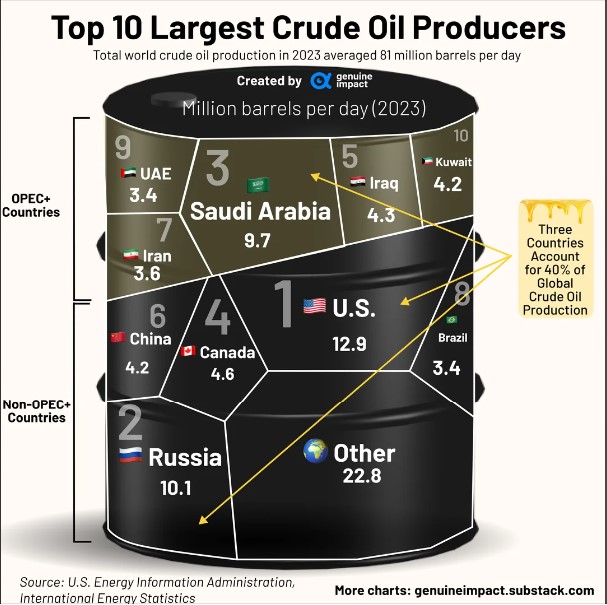
With eight OPEC+ producers planning to ramp up production in the coming months this should lead to reduced oil prices and easing the energy component of inflation.
It seems that the Federal Reserve’s sought-after data and trends are aligning, providing a clearer picture of the economic landscape.
-
PCE as Expected but What is Rounding Numbers.
Personal Consumption Expenditures (PCE) came in as expected. Inflation rose by 0.3%. The year-over-year inflation also remained the same at 2.7%. A significant part of that was due to the increase in energy costs. We had expected a decline in inflation.
Let’s take a closer look at these numbers. The core rate, which excludes food and energy costs, rose by 0.2%, but it actually increased by 0.249%, rounded down to 0.2%. The year-over-year inflation number is not 2.7% but actually 2.75%, again rounded down.
The larger question is why are we looking that closely? If you are going to win, win big. Swimming competitions can come down to 1/100th of a second. Do you know what that is? That’s two coats of paint.
Inflation is no longer trending upwards, and we anticipate it will decline as the year progresses.
Rates continue to improve this week. Have a great weekend and enjoy the Sun.

-
Who benefits from High interest rates an low housing inventory?
Those with money and property are reaping the benefits of the high-interest rate environment. Yields on savings accounts have surpassed 4.5%, and low housing inventory has driven home values to unprecedented heights. The stock market has also seen remarkable gains, with the NYSE hitting 40,000 for the first time. The S&P 500 rose 23% last year and is up over 11% this year.
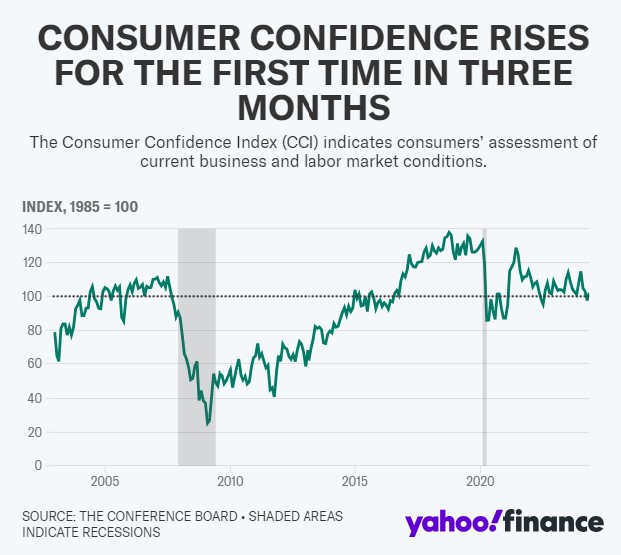
When I see the Consumer Confidence Index (CCI) rise above 100, I can’t help but wonder how it’s possible.
There is a segment of the population that is very content to keep things exactly as they are.
The Federal Reserve faces a dilemma. Plans for home purchases are at their lowest level since August 2012, and lower-income consumers are being hit the hardest.
High Federal Reserve rates might be causing inflation rather than curing it. The economy is being driven by the wealthy, particularly those earning $100,000 or more. This group comprises 37.43% of households, totaling 49,281,397 households.
-
Home Values continue to Rise, but there is a gap that keep growing.
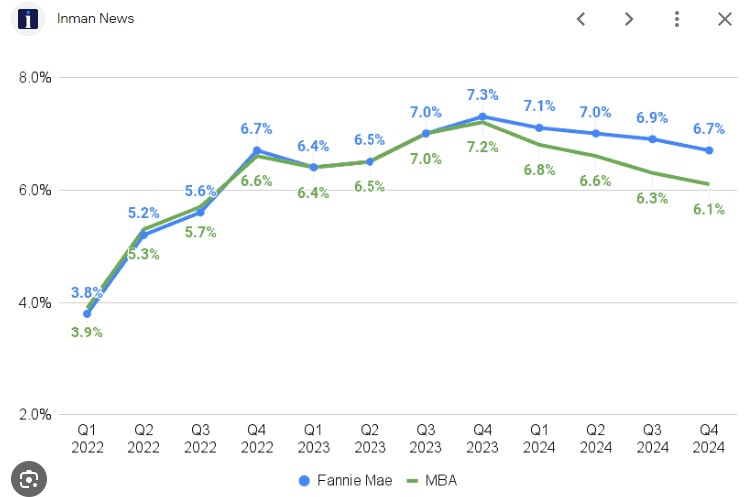
Case Shiller Home Price Index, year over year 6.5%.
FHFA House Price Index year over year 6.7%.
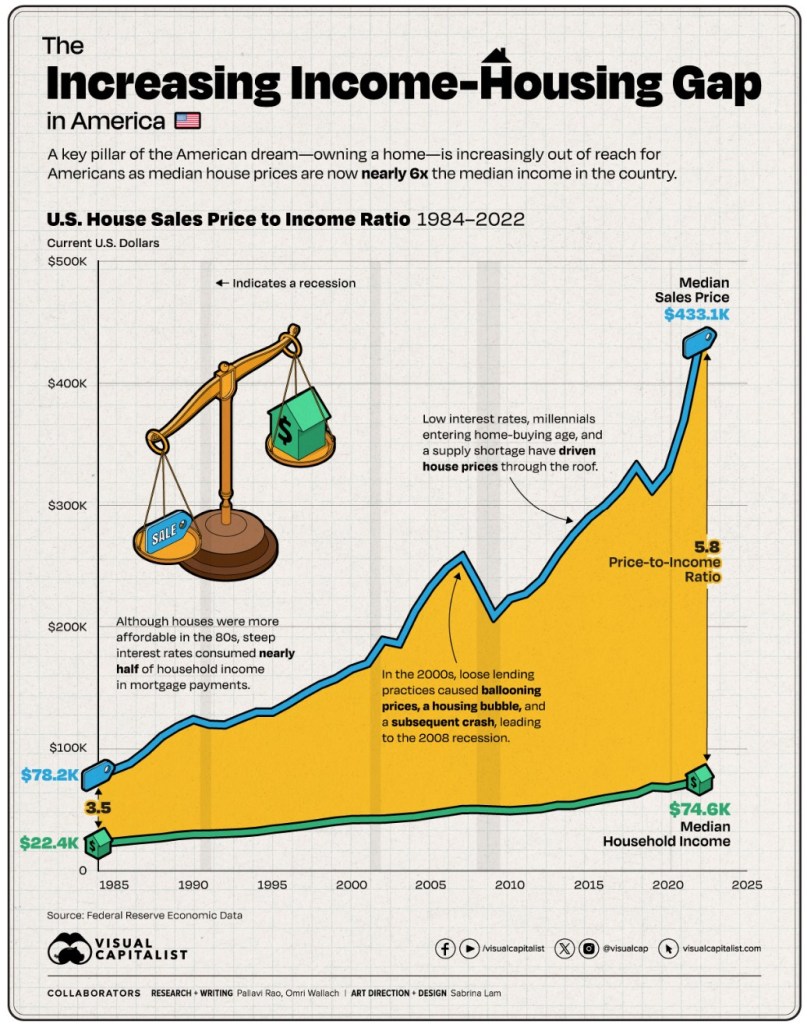
The problem is that the affordability gap continues to widen, driven by the persistent housing shortage. Incomes can’t keep up, so something has to give.
It’s a conundrum. Lower interest rates enable sellers to sell and buyers to buy. This frenzy can lead to skyrocketing prices as more buyers emerge. We saw this happen in 2020 when rates dropped.
I believe that lower rates will encourage sellers to finally put their homes on the market. Many of my clients are ready to sell. Some bought during the pandemic and have since realized their new location no longer suits them. Others are looking to downsize or upsize.
Even though close to 30% of the home purchases are first time home buyers, quite a number of them are getting help from their parents to make up the Price to Income gap.
-
The Insidious Damage of Revised Numbers.
The market reacts to the news not the revision. When we look at inflation as an example, we always couch it in terms of “year over year”. But most of the other numbers and gauged by “month over month”.
A good example is todays Durable Goods Orders. We expected -0.8%. What we got was a rise of 0.7%. The market, specifically the Bond market saw the 1.5% differential and reacted accordingly (negatively).
Last months reading of 2.6% was revised lower by 1.8% bringing March to 0.8%. The actual reading today fell -1.0% which was worse than the expected -0.8%.
Another example: Core Durable Goods rose 0.3%, which was stronger than the estimates of 0.1%. There was a negative revision from the previous month of 0.3%, which brought March to -0.1%. When factoring that in, the reading was 0.0%, lower than the expected 0.1% stated above.
The Bond Market, which is what rates are based on, reacts to the headline not the math. The consumers are slowing their roll. First it was Retail Sales and now its Durable Goods.
Walmart and Target both announced store wide price cuts. Others will follow and inflation will drop.
The Train is coming but the Feds are too busy looking in the rear view mirror to realize they are parked on the track.

-
You say Potato, I say Potaato
Fed Minutes can be a bit frustrating to read. Here is an example.
“Some participants emphasize that the recent increases in inflation had been relatively Broad Based”.
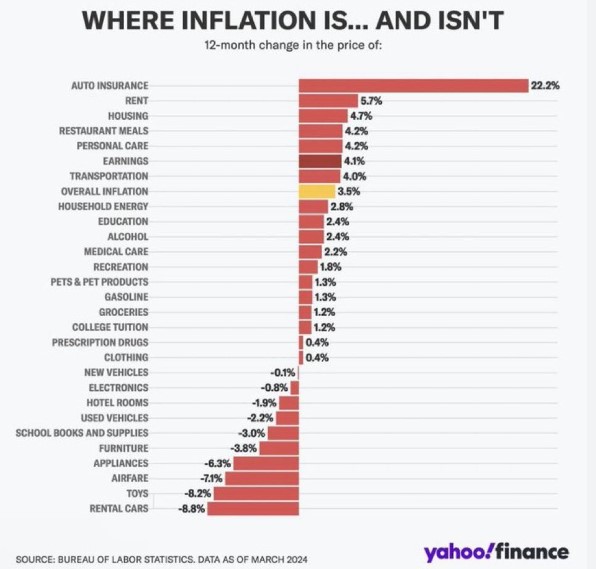
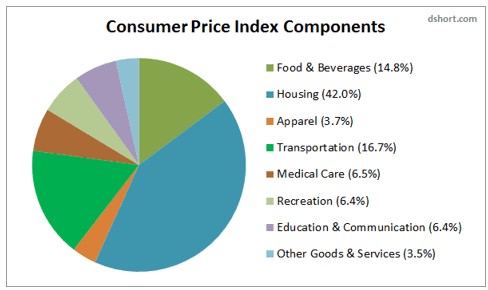
Take a look at the graph below. The top three items are Auto Insurance, Rent, and Housing. Housing and Transportation make up 58.7% of the Consumer Price Index (CPI).
If we pull these out, inflation is only up 0.27% year over year. This is not broad-based but specific.
Inflation is stubborn, that is true, but its makeup is also as important.
The bond market reacted to the news today on Initial Jobless Claims and the Fed Minutes. Rates slipped but only a bit.
-
Rates hold onto gains this week. Fed Minutes out today.
At 11am PST the Fed Minutes for the May 1st Fed meeting will be released.
- Next move may not be rate hike
- Inflation continue to stall.
- Unemployment rate going up
- Feds slowing down Balance sheet reduction (quantitative tightening)
- Feds increasing their Balance sheet (quantitative easing) -good for rates
Existing home Sales
This is the sale of existing homes not new builds.
- Fell 1.9% in April. Slightly lower than expectations
- Higher rates in February did not stall sales
- Inventory increased 9% mont/month
- Inventory up 16% from last year.
- Median home price up 3.7% to $407,600
The bigger news is first time home buyers make up 33% of the sales, which is up sharply. Cash buyers accounted for 28%, Investors 16%.
27% of homes sold above the list price. Mortgage applications down slightly and 11% lower than this time last year.
Inventory is headed in the right direction and with fewer borrowers looking, Now might be the right time to make your move.
-
8 Fed Members Speaking this week. What to expect and what we know this morning.
Raphael Bostic a voting member and Fed President said he thinks inflation will continue to come down, but slowly. He has talked to a lot of business leaders, and they are all telling him that things are slowing down.
Leading Economic Index
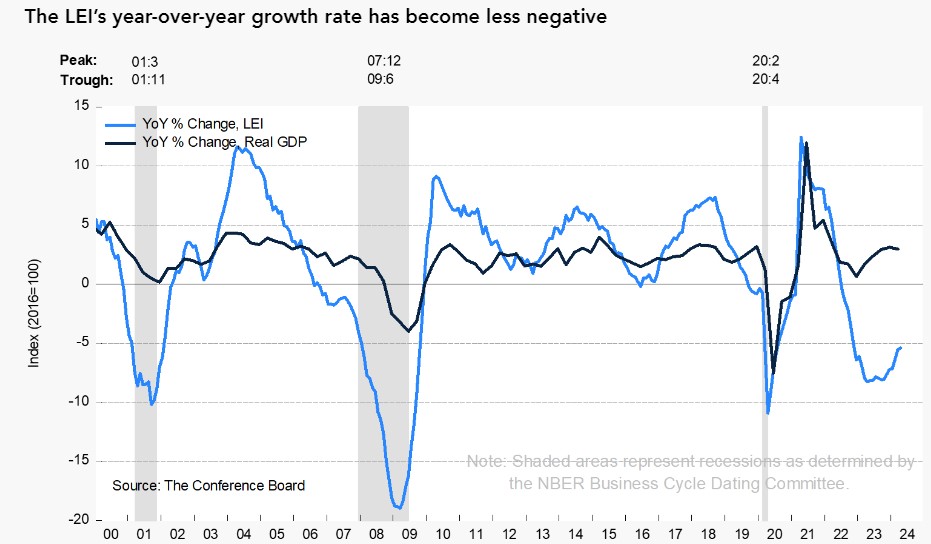
The Conference Board released their LEI, which decreased in April by 0.6%. We have had 22 months of negative readings in a row. This points to serious headwinds to growth ahead.
What’s going on this week
- Tuesday: CoreLogic Rent Index
- Wednesday: Mortgage Apps, Existing Home Sales, 20-year bond Auction, Fed Minutes
- Thursday: initial Jobless Claims, New Home Sales
- Friday: Durable goods Orders.
How will this affect Mortgage Rates?
What the Federal Reserve is hearing from the market aligns with the broader economic observations both anecdotally and technically. This indicates that the Fed is analyzing the data and recognizing that a recession may not be imminent. However, they might need to reconsider implementing rate cuts sooner rather than later.
Translation
Mortgage Rates should move in a positive direction moving forward.
-
Trading Down, Feds are you Listening?
Being in this business for over 20 years, there are words that stick out like a sore thumb.
One of those words is Trading down. During the 2008 Financial crises, I recall the headlines about how well the beer industry was doing. Generic brands got a boost as did other Trading Down brands.
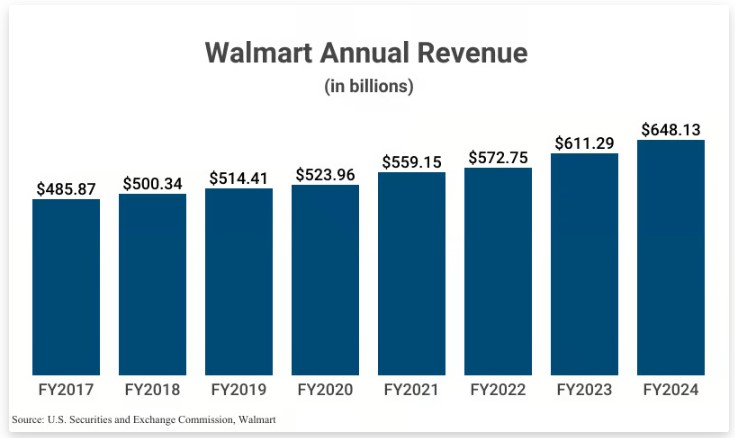
Walmart posted strong earnings yesterday. The reason this is important is they are a good barometer on the overall economy.
The higher income earners are Trading Down. They have a long way to drop opposed to lower income consumers who are close to the bottom. This is a sign that consumers are struggling with the pandemic savings exhausted and personal savings rate at very low levels.
Credit appears to also be tapped out. Buy now pay later has a very high delinquency of over 43%.
-
It’s not Free, but it’s just Free enough.
The use of sales incentives ticked up to 59% in May. The May HMI survey shows 25% of builders cut home prices to boost sales.
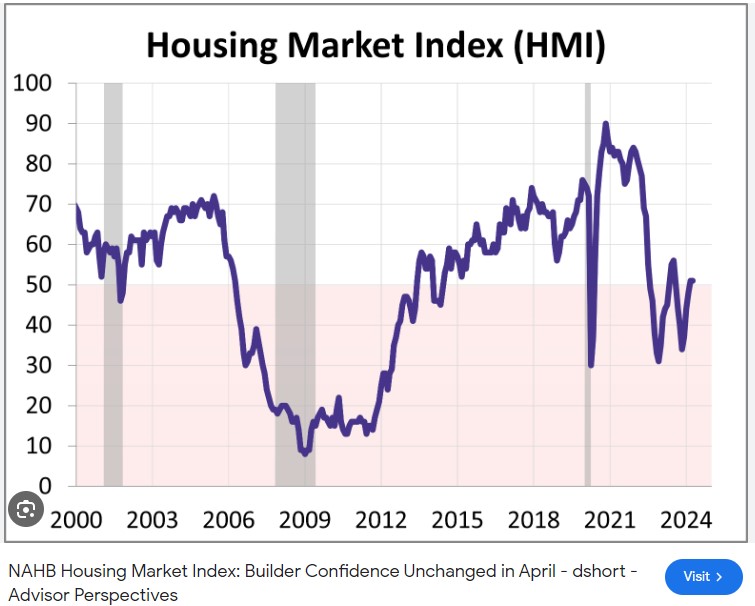
Its a builder confidence thing. The May NAHB Housing Market Index, which measures builder confidence, fell 6 points to 45. It’s under the 50 number but this is still an expansion confidence. Weak but still confident.
Initial Jobless Claims fell 10,000 to 222,000. This is higher than previous levels.
Continuing Claims rose 13,000 to 1.794M. These are the highest numbers since November 2021.
Big bond movement yesterday and holding onto those gains today.
-
Subscribe
Subscribed
Have a WordPress.com account? Log in now.

