-
Goolsbee and the rise of the Doves
Chicago Fed President, Austin Goolsbee is one of the most Dovish Fed members this last year.
Here is his comment:
“You only want to be this tight on purpose if you’re trying to cool an overheating economy, and this is not what is overheating looks like.“
The Labor market is cooling by all measures. When asked about a 25bp or 50bp cut at the September 18th meeting, he pivoted stating that it doesn’t matter which they choose, what is more important is the longer term view of Policy.
Home Prices up again.
The Case Shiller Home Price Index, the gold standard for appreciation, showed home prices rose 0.2% in June. This is an all-time high. Prices are now up 5.4% year over year.
Rent concessions.
There has been a slew of multi-family apartments built or in the pipeline to be completed. This has drawn the vacancy rate up to its highest levels in four years.
Some of the concessions are a month or two months free rent and discounts on utilities. Quite a shift from two years ago.
Mortgage Rates continue to move in the right direction. We are anticipating a very busy Fall and Winter not just for refinances but for purchase transactions. The sellers are starting to realize that with rates lower, they can also get in the purchase market with the added benefit of adding their home to the pool.

-
Ducks in a Row … Please, Mine Aren’t Even in the Same Pond, and I Think One Might Be a Flamingo
As we barrel towards an exciting change in the Mortgage and Housing market, it’s best to start getting your documents in order.
Let’s take a look at the numbers 2019 vs Today
- Core PCE: 1.8% vs 2.6%
- Unemployment Rate: 3.6% vs 4.3%
- Job Openings to Unemployment ratio: 1.24% vs 1.2%
- Hiring Rate: 3.9% vs 3.4%
- Fed Funds Rate: 2% vs 5.375%
- 10-year Treasury: 2.8%-1.9% vs 3.80%
- 30-year fixed Mortgage Rate: 4% vs 6.5%
We know inflation is higher today but has been dropping precipitously. The Labor market is weaker but the Fed Fund rate remains much higher than 2019.
Durable Goods Orders jumped 10%, with expectations at 5%, but most of that boost came from aircraft orders. When you take those out of the equation, the numbers actually dipped 0.2%. It’s a reminder that a single statistic doesn’t tell the whole story.
Here is a fun link to a video I did last week regarding refinancing. Have a fantastic week.
-
Everyday is a School Day – Chris B.
Fed Chair Powell sounded very dovish about September 18th rate cuts.
“The time has come for policy to adjust. The direction of travel is clear, and the timing and pace of rate cuts will depend on incoming data, the evolving outlook, and the balance of risks.”
Powell also said, that inflation has declined significantly and his confidence has grown that inflation is on path to 2%.
New Home Sales
New Home Sales, which measures signed contracts on new homes, rose 10.6%. This was a blowout from the estimated 1% rise.
If you or someone you know is looking to buy or refinance, tell them to get their ducks in a row.
Call us 1-800-424-9293 or email jkammer@cfmtg.com

-
BLS is BS and the Feds agree, finally.
Yesterday, we saw the Bureau of Labor Statistics (BLS) revise its jobs report, revealing that the number of jobs from March 2023 to March 2024 was overstated by over 818,000.
On the same day, the Federal Reserve released the minutes from its July 31st meeting, where they acknowledged the errors in the BLS report. Despite the continued goal of achieving 2.0% inflation, the inaccuracies in the jobs data have increased the pressure to lower interest rates sooner rather than later.
The Fed also noted that consumers are increasingly making only minimum debt payments, a sign of growing financial stress. The key takeaway from the minutes is that the Fed is laying the groundwork for a potential rate cut on September 18.
Additionally, Philadelphia Fed President Patrick Harker, who is not a voting member this year, made a noteworthy statement.
“as the rates come down we will see the Lock-In Effect subside and there will be more supply. “
He was mainly referring to builder costs and financing coming down but it also applies to those homeowners with low interest rates.
Get yourself, clients and friends ready for rates to drop and the housing market to really heat up.
-
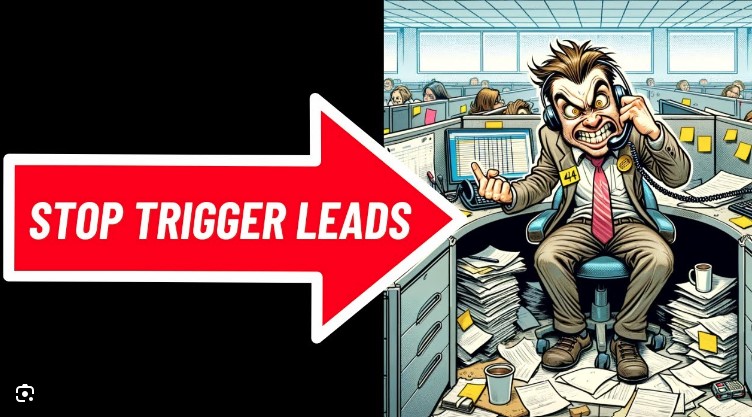
What is a Trigger Lead and it’s negative impact on the Borrower.
When a Borrower applies for a Mortgage for a purchase or refinance the Credit Bureau’s Experian, Equifax and Transunion sell these leads that contain the customers name, contact information and other data within 24 hours of the application. Clients can get over 50 phone calls a day.
We in the Lending Industry cannot stop this from happening but the borrower can stop these Trigger Leads from being generated.
Our mortgage applications are Soft Pull only until we verify the client has opted out or direct them to opt out.
Click link below to opt out of all Bureau’s at once.
https://www.optoutprescreen.com/
“A trigger lead is a prescreened offer or firm offer of credit or insurance that occurs when a lender pays a credit reporting agency to generate a report on a list of consumers. The most common trigger event is applying for a mortgage. When a lender pulls a borrower’s credit report, the action triggers an inquiry, which is then sold to other lenders as a lead. These leads contain the consumer’s name, contact information, and other data. The leads are created and sold within 24 hours of a loan application.”
Please share and call/email with any questions.
-
Let’s talk Leading Economic Index, Ok don’t fall asleep just yet…
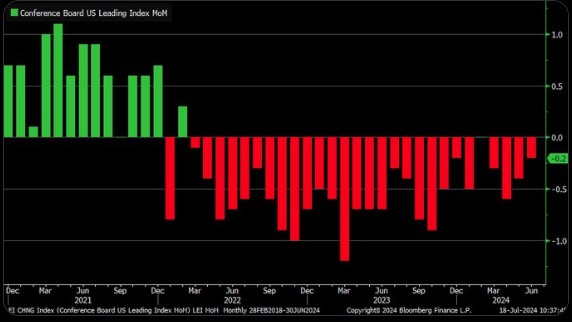
The Conference Board released their Leading Economic Index, which decreased in July by 0.6%. We expected -0.3. The index has been negative 27 of the 28 months.
The LEI has been trending down but the long-term growth has become less negative. Meaning the economy is decelerating but at a slower pace “soft landing”.
With Mortgage Rates decreasing and likely to drop further, this trend could encourage more sellers to reenter the market. Lower rates can lead to increased buyer activity. Sellers are anticipating stronger demand and favorable conditions for selling.
Many of us are sitting on the sidelines, waiting to get in the game. Well, we’re already halfway through the first quarter, so it’s time to put on your helmet and get on the field.
-
We are a Whip and a Whisker Away but will the Feds pay attention.
Every year, the central banks from around the world meet at the Jackson Hole Symposium in Jackson Hole Wyoming. This is an important meeting the Feds have used to signal policy changes and long-term outlook for the Fed Fund Rate.
The meeting starts Thursday, with Fed Chair Powell speaking on Friday.
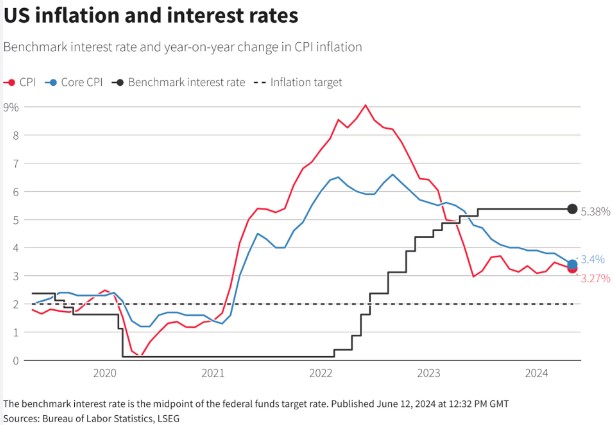
Everything has changed in the economy except the Fed. Back then the Fed Funds rate was between 5.25% and 5.50% as it still is today. Lets look at the numbers.
2023
- Core PCE: 4.3% – Personal Consumption Expenditures
- Core CPI: 4.7% – Consumer Price Index
- Unemployment Rate: 3.5%
2024
- Core PCE: 2.6% – Personal Consumption Expenditures
- Core CPI: 3.2% – Consumer Price Index
- Unemployment Rate: 4.3%
The August Jobs Report will be released September 5th with the anticipated unemployment rate at or above 4.3%. The Feds will be pressured to cut 50pp but if the unemployment rate drops, they may only cut 25pp.
Thinking about Refinancing, what if we not only drop your rate but drop it down a point lower for the first year on us… Lets talk

-
‘A simple fact that is hard to learn is that the time to save money is when you have some.’ – Joe Moore
With that said, lets talk refinance and the raw numbers.
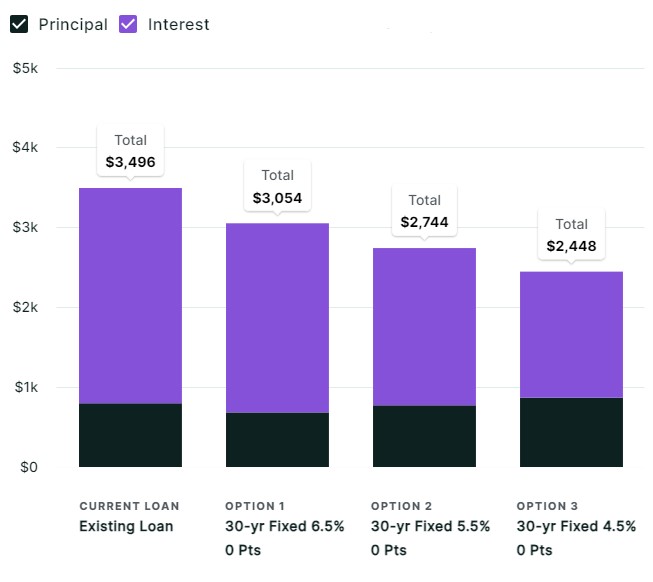
The example below is every point drop for a $100k loan start rate 7.50% Principle and Interest payment is $699 per month 30y term.
- @6.50% $632
- @5.50% $567
- @4.50% $506
If you have a $500k loan 30y term monthly savings.
- @7.50% $3,496
- @6.50% $3,160 -Savings $336 annual savings $ 4,032
- @5.50% $2,838 -Savings $658 annual savings $ 7,896
- @4.50% $2,533 -Savings $963 annual savings $11,556
We do a soft credit pull and can get you pre-qualified now before the rates drop.
YourApplicationOnline.com click to apply for your custom graphical analysis.
-
It’s Not that the Wind is Blowing but WHAT the Wind is Blowing.
The 10-year Mortgage Bond is holding below 4%. This is a positive sign for Mortgage rates moving forward.
Fed Governor Michelle Bowman seems unaware of the shift in unemployment, which has risen from 3.4% in April 2023 to 4.3% today. To put this into context, every time unemployment has increased by that much since 1948, a recession has followed.
“the unemployment rate, while higher, is still historically low at 4.3%” – Michelle Bowman – voting member
Another aspect of the unemployment rate is how it’s collected and the participation level. The Business Survey, which provides the headline jobs figure, has seen a significant decline in participation, dropping from the usual 60% to 43%. Meanwhile, the Household Survey, which determines the unemployment rate, has also declined but still remains at 70%.
She goes on to talk about PCE and Core PCE still being above the target 2.0%.
This week, we’ll kick off with inflation data. The Producer Price Index (PPI), which measures wholesale inflation, is expected to rise by just 0.1% in July.
The year-over-year headline figure is projected to decrease from 2.6% to 2.3%. This is likely to be bond-friendly, indicating rate-friendly news.
My point is, when the wind is blowing, don’t just watch the trees swaying back and forth—look closer to see what’s actually hitting the trees.

-
Everything Matters, That’s why I don’t Care.
The weight of everything overwhelms its importance. What is the right choice? What if we are wrong? There is also a dilution of impact—if every action is critical, it becomes difficult to prioritize.
We need freedom or liberation from overthinking.
So, what am I getting at? Simply put, the Federal Reserve has overthought everything and needs to take a deep breath and step back. The Data is pointing to a slowing economy and lower inflation.
- Tom Barkin Richmond Fed President -Stock Market Selloff this week, Not something monumental. We can Steadily cut rates.
- Jeff Schmid Kansas City Fed President – Gives more confidence inflation headed to 2% goal.
- Austan Goolsbee Chicago Fed President – Central Bank’s policy is too tight.
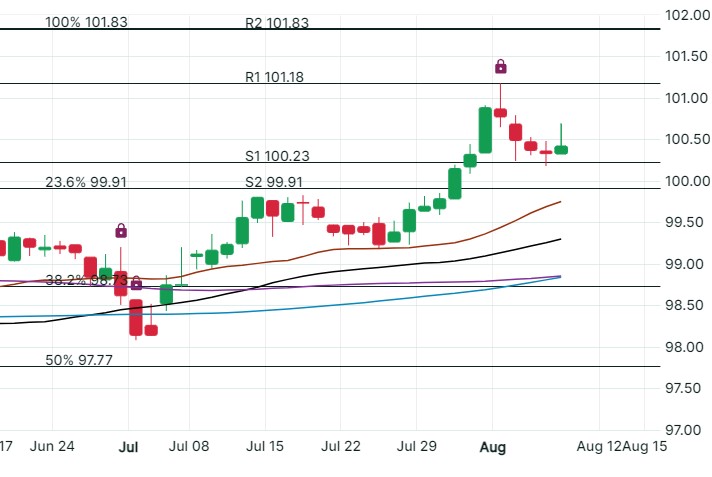
Below graph shows the rate improvement to the right. Up is lower rates. I am encouraging clients to get pre-approved for a refinance or purchase. we do soft credit pulls so no harm looking under the hood.
-
Subscribe
Subscribed
Have a WordPress.com account? Log in now.

