-
It’s All that it tells us, and All that it Refuses to tell us. Let’s talk “Risk Off Trade”
Investors are shifting away from riskier assets like stocks and crypto, moving their money into the bond market—a phenomenon known as “Flight to Safety.”
A “risk-off” trade is exactly what it sounds like—when uncertainty rises, investors pull back. While the stock market may be exciting, the bond market offers a sense of security—like a cozy home with warm cookies and milk.
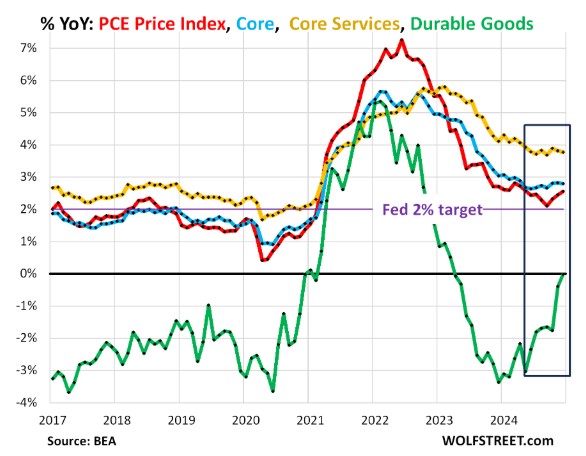
The Personal Consumption Expenditures (PCE) report showed headline inflation rising 0.3% for the month, while year-over-year inflation eased from 2.6% to 2.5%, aligning with expectations.
The core PCE, which excludes food and energy costs, also increased by 0.3% for the month, with annual inflation declining from 2.9% to 2.6%.
As inflation does, so does the interest rates.
-
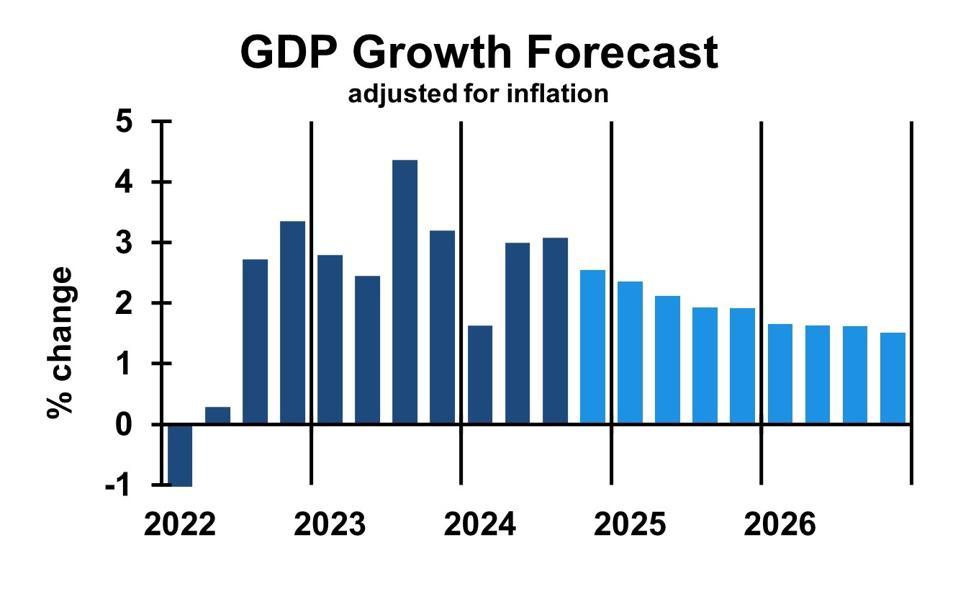
GDP is like a bathroom scale – it might tell you you’re getting bigger, but it doesn’t tell you if you’re actually getting healthier.
Gross Domestic Product – Q4 2024 was inline with expectations at 2.3%. But may not tell the whole story. Q1 and Q2 should give us insights on Tariffs and the Federal workers being fired or laid off.
Factors affecting GDP
- Consumer spending Increased consumer spending contributed to the increase in GDP in the fourth quarter.
- Government spending Increased government spending contributed to the increase in GDP in the fourth quarter. But will change.
- InvestmentA decrease in investment partly offset the increase in GDP in the fourth quarter.
- Imports Imports decreased, which is a subtraction in the calculation of GDP.
Business investment
Business investment has been relatively strong since the start of 2024. Markets expect the incoming administration to further boost the attractiveness of business investment.
-
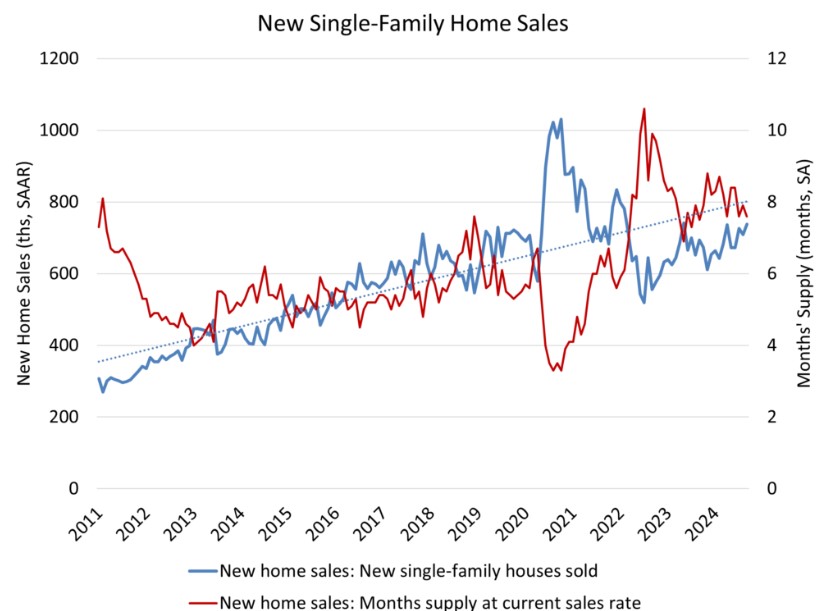
New Home Sales are weird. I mean Strange. What’s the actual number?
New Home Sales Decline 10.5%, But Supply Tells a Different Story
Recent data shows that new home sales fell by 10.5%, a steeper decline than expected. Meanwhile, the supply of new homes has increased from 8 months to 9 months.
However, out of the 657,000 homes counted in inventory, only 115,000 are completed, while 106,000 haven’t even started construction—and some may never be built.
This means the actual available supply has effectively decreased by 2.1 months, making the housing market even tighter than it appears.
Builders are growing cautious. With rates lingering around 7% and no clear path to lower levels, they are proceeding with caution and hedging their bets.
-
$600k purchase last year, increased value by $24k today.
The Case-Shiller Home Price Index, widely regarded as the gold standard for measuring home appreciation, reported a 0.5% increase in home prices for December, with a 3.9% rise year over year.
Meanwhile, the Federal Housing Finance Agency (FHFA) released its House Price Index, which excludes cash buyers and jumbo loans, focusing instead on single-family homes with conforming loan amounts. According to this report, home prices have increased by 4.7%, reflecting continued market strength. A 4% appreciation is a solid indicator of a healthy housing market.
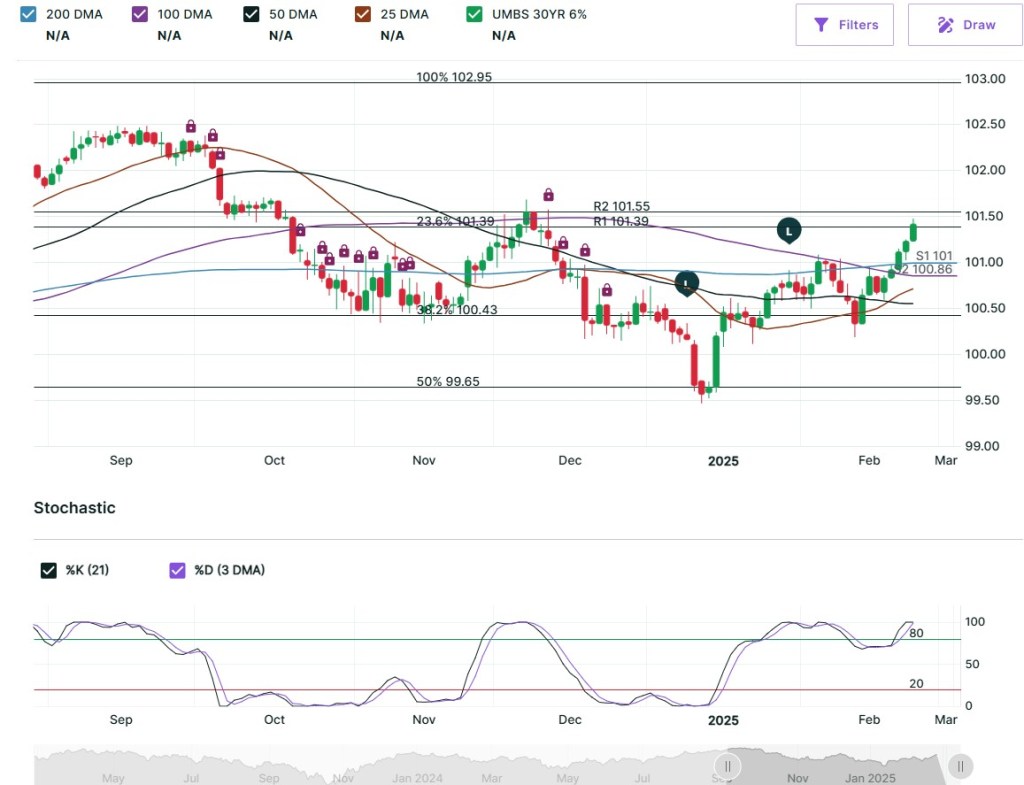
On the mortgage front, Bond prices have risen significantly over the past week, leading to lower yields and, in turn, lower mortgage rates. We’re hopeful this trend continues, especially with the upcoming PCE report on Friday, which could have a major impact on rate movements.
Lower rates ahead? Let’s stay tuned.
On the Chart, up ie Green is lower rates.
-
But now I am Six. I’m as clever as clever, So I think I’ll be six now for ever and ever. – A. A. Milne
There is a charm and simplicity to this poem. But just as growing up is inevitable, so is the change in the mortgage industry.
Rates fluctuate, regulations evolve, and the market conditions shift.
Professionals and homeowners must embrace change rather than try to “stay six forever”. -Adaptability.
All eyes are on Friday’s release of the Personal Consumption Expenditures (PCE) report, which measures U.S. household spending on goods and services.
Markets anticipate a drop in inflation from 2.6% to 2.5%, a welcome sign for the bond market and interest rates.

-
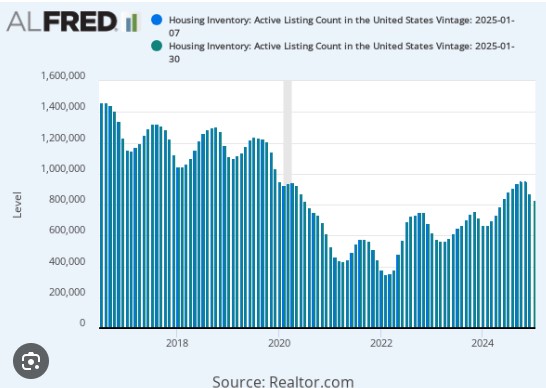
Supply is Not keeping up with Demand. Inventory up 16.8% but not good enough.
Let’s go to our way-back Machine, lets say back to 2022 when the inventory was below 500,000. Pre-Covid numbers averaged closer to 1.4M. currently we are at 1.18M.
We have a 3.5 months’ supply of homes up from 3.2 in December.
Median home price was $396,900 down slightly from December. 28% first time home buyers, 29% cash – down from 32%.
Housing market staying strong as inventory try’s to keep up.
Have a great weekend. ww.YourApplicaitonOnline.com
-
Fed at Net Neutral and QE, QT explained.
I’m sure that got your undivided attention – Not…
But its important and why the rates may actually start dropping.
Quantitative Easing (QE) is when a central bank injects new money into the economy by expanding the money supply. Think back to the 2008 financial crisis and the COVID-19 pandemic—during these periods, the Fed was aggressively pumping money into the system.
Quantitative Tightening (QT), on the other hand, is the process of reducing the money supply. The Fed has been shrinking its balance sheet for years, which has contributed to rising Fed rates and mortgage rates.
Net Neutral is exactly what it sounds like—neither QE nor QT. It’s a steady-state monetary policy where the Fed maintains the status quo without expanding or contracting the money supply.
This is a big deal. Net Neutral is the next step to QE and lower interest rates.
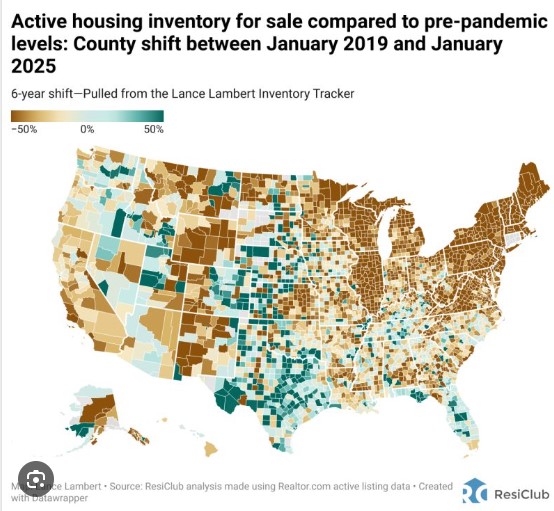
We’re starting to see a shift toward a buyer’s market, as evidenced by the increasing number of listings being pulled. After years of rapid home value appreciation, prices have leveled off and are beginning to normalize. Sellers are catching on, reassessing their pricing strategies, and either adjusting their listings or temporarily stepping back from the market.
http://www.YourApplicationOnline.com
-
FED Speak and they seem to be reading from the same playbook.
Fed Pres Harker, Fed Governor Waller and Fed Pres Bullard all seem to be reading from the same book.
They are all saying, January was not a surprise historically and not overly concerned with potential tariffs.
The NAHB Home Builder Sentiment Index dropped 5 points due to concerns over tariffs, mortgage rates, and rising housing costs—particularly with Canada, which supplies about 30% of our soft lumber.
Housing starts and permits have declined, but only relative to December’s numbers. The key factor in December? Lower mortgage rates. And it wasn’t even a significant drop—just the expectation of lower rates was enough to drive demand.
Now, imagine what will happen when rates actually decline in a more sustained and meaningful way.

-
Don’t play Chess on a Checkerboard.
Regardless of your skills, using the wrong strategy or approach for a given situation is dangerous.
Fed Governor Waller spoke yesterday with a dovish tone, downplaying the significance of January’s inflation data, attributing it to historical anomalies and seasonal factors despite its unusual magnitude.
He also expressed little concern about the impact of tariffs on inflation, characterizing them as a one-time price adjustment rather than a driver of sustained inflationary pressure.
I disagree. Waller is playing Checkers on a Chessboard not the other way around. Time will tell and I hope he is right.
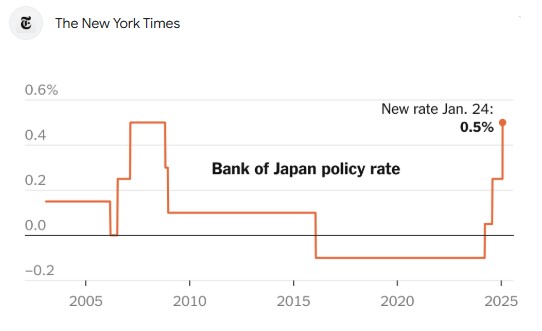
We are watching Japan and their unexpected kike of their central bank rate. Highest since 2009.
Rates are still holding onto gains the last week.
http://www.YourApplicationOnline.com
-
Knowledge is knowing that a tomato is a fruit, Wisdom is knowing not to put it in a fruit salad.
Stocks and Mortgage Bonds are trending higher today. As a reminder, bond prices and yields have an inverse relationship (consider that my Valentine’s plug)—when bond prices rise, yields fall, and interest rates follow suit.
January’s Retail Sales report came in weaker than expected, declining 0.9% versus the anticipated 0.1% drop. This suggests consumers may be reaching their spending limits. Historically, post-holiday spending slows, but this decline is more significant than usual.
Want to get big corporations’ attention? Use the most powerful tool you have—your wallet. Hold onto your money, and they’ll come running back with lower prices.
Lower Prices, lower Inflation, Lower Rates.
http://www.YourApplicationOnline.com

-
Subscribe
Subscribed
Have a WordPress.com account? Log in now.

